Showing posts with label Data Speeds. Show all posts

Monday, 19 August 2019

Statistics from Hajj 2019 (1440 H)


The Saudi Arabian Communications and Information Technology Commission (CITC) has released the statistics for mobile data & voice calls from Hajj this year. While the majority of activity is centered around Makkah (Mecca), Medina (Madinah) becomes highly active too. To give an idea of why this is important, see this picture below


The city of Makkah is always full of people but during Hajj time, around 4-5 million people gather in a small area. This is the most challenging network deployment because people are always on their smartphones, talking, live streaming, video calling, etc. There is also no end time. This continues generally round the clock.


Here is the summary of stats from CITC announcement:

The use of Information and Communication Technology  services (ICT), during this season of Hajj 1440-2019, witnessed  a significant rise; the average number of subscribers reached nearly 7.4million per day, the number of voice calls exceeded 309 million hours, and the total data consumption during the entire season exceeded 30.2 thousand terabyte, with a rise  of 26% compared to last year, according the statistics issued by CITC about the ICT services consumed in Makkah Almukarramah, Al Madinah Almunawarah and Holy sites throughout Hajj season 1440-2019.

Implementation of daily measurements showed that the Internet average download speed is 44.83 Mbps in Makkah Almukarramah with a rise of 69% compared to last year. While in Madinah it reached 48.14 Mbps with a rise of 54% compared to last year, due to availability of advanced infrastructure for communication networks and massive increase of their capacity.

In an earlier announcement CITC had said:

The statistics also included average of daily data consumption per person; the average rate reached (299.12 MB / subscriber) compared to daily global data consumption rate per person (180  MB / subscriber), noting that the most popular applications are  (in order): YouTube, Snap Chat, Facebook, WhatsApp, Instagram.

The statistics additionally mentioned that average Internet download speed reached (45.61) in Makkah, achieving an improvement rate of (71.79%) compared to last year.  The number of domestic calls reached (22.7 millions)  while  international calls reached (7.6  millions  ) with success rate of 99.06%.

Note that the two pics above are from CITC tweet below.


Related Posts:

Thursday, 19 July 2018

Malaysia: Challenges of 4G


It has been more than 5 years since 4G LTE was officially rolled out in Malaysia. Today, there are six 4G LTE operators in the country and the cost of data is so much more affordable than before. The mobile operators are – Maxis, Celcom Axiata, DiGi, Webe, U Mobile and Yes. In May 2017 Celcom Axiata carried out what is claimed to be Malaysia’s first 5G trial. The test was also said to have demonstrated futuristic 5G use cases, such as robotic control, connected environment, virtual reality, Internet of Things (IoT) applications and 4K video streaming.


Although 4G technology is available 74.88% of the time to Malaysians, its speed leaves much to be desired. According to a report by OpenSignal, a company that specialises in wireless coverage mapping, the 4G speed in the country is only 14.83Mbps.

With that, OpenSignal ranks Malaysia as one of the lowest 20 countries in the list which was led by Singapore at 44.31 Mbps while India being ranked last due its 6.07 Mbps download speed.


However,  LTE availability in Malaysia was more promising. The report pointed out that the LTE connectivity in the country can be accessed 74.88% of the time throughout Q4 2017. While it is better than Algeria which occupy the bottom of the list due its 40.94% rating, Malaysia is nowhere near South Korea whereby users were able to achieve LTE connection 97.49% of the time.


According Open Signal test results regarding the highest 4G/3G download speeds and the lowest latency for both 4G and 3G among operators: Maxis comes out on top overall. 


Coming in at second place is Yes. When it comes to 4G, Yes records an incredibly high 93.18% availability followed by Maxis at 80.45%. OpenSignal notes that 4G availability isn’t a representation of geographic or population coverage, but rather how often its users are connected to a 4G network. It is worth mentioning that Yes itself runs on a pure 4G network so if it goes out of coverage, there’s no 3G or 2G network to fall back on. Yes also records the highest overall average download speed of 19.03Mbps and it isn’t surprising since its users are connected only on 4G, while other telcos have samples measured on 3G.

If we look at the rest, Celcom (16.15Mbps) takes 3rd place followed by Digi (11.77Mbps) on 4th and U Mobile (7.2Mbps) at 5th place for 4G downloads. Webe (or now known as UniFi) is ranked the lowest at 6.76Mbps. When it comes to 3G, 2nd place goes to Celcom (2.9Mbps) followed by U Mobile (2.78Mbps) and Digi (2.58Mbps).

You can read the full OpenSignal report here.

Friday, 15 December 2017

Disruptive Reliance Jio on the road to 4G leadership

Continuing from our earlier post on India in October.

According to this BGR news report:
2017 was a significant year for Indian telecom during which 4G became the new norm. Usage exploded riding primarily on Reliance Jio — the 15-month old network that is already the world’s fastest-growing telco — and the effects trickled down to other operators too. Nearly 4 million TB of 4G data has been consumed by Indians this year, according to a TRAI estimate. Consumers relished swathes of data sometimes “effectively free” and sometimes at incredibly low prices, and hordes of first-time smartphone buyers were inducted into the world of mobile data. The year came to be defined by the stiff price war between incumbent telcos and disruptor Jio.
According to this tweet by Neil Shah, Counter Point:


4G LTE subscriptions: 135 Million
Data Consumption : 10GB per month / user
VoLTE calls : 626 minutes per month / user
Video Consumption: 14 hrs per month / user


A similar picture was reported by Tefficient:
These customers generated 3780 petabyte of mobile data. It's by far the biggest network in the world. The graph suggests that might be around 80% of India's total - Q3 isn't reported by the others yet. Per subscription, that is 9,6 GB per month which means that Jio might challenge the global usage leaders of the world - 3 Austria, DNA and Elisa Finland and FarEasTone and Taiwan Mobile from Taiwan.


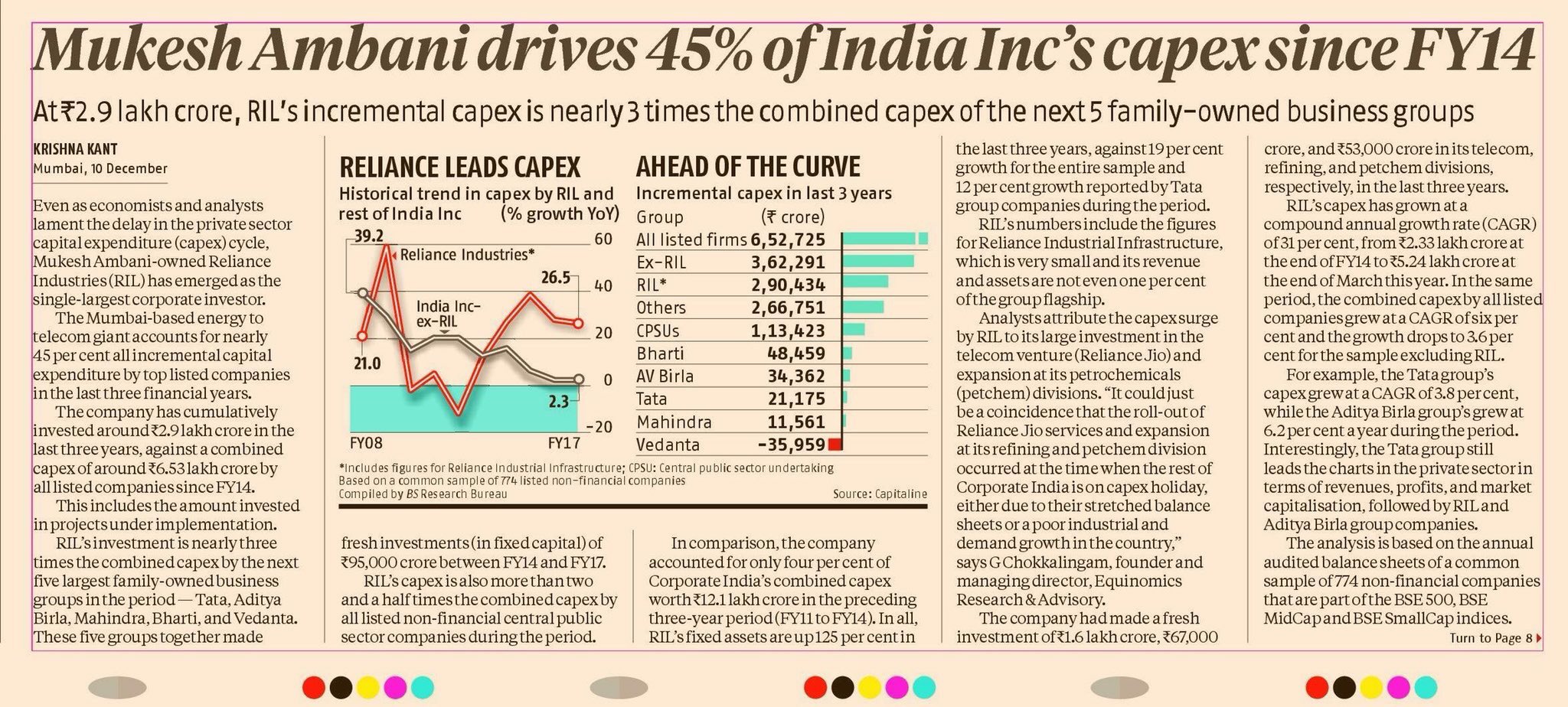
Its interesting to note that no only are Reliance Jio's users the highest data consumers in the world, its also driving India's infrastructure building activity. According to the newspaper report below, Reliance Industries has been responsible for 45% of capex spend in India in the last 3 years.


According to GadgetsNow:
India's current mobile data subscriber penetration stands at 40 per cent which is expected to double to 80 per cent by 2022, according to Crisil's predictions. 
"LTE services have taken the leading role in the unprecedented increase of data users in the past year, in large part thanks to Jio," the report said.
The 3G4G Small cells blog has a post on small cells rollout in India here. In addition, Tareq Amin, Senior Vice President, Reliance Jio Infocomm recently spoke in the TIP summit. His talk is embedded below.


One could argue that rolling out 4G can only be considered successful if the end users can reliably make use of it. According to Opensignal blog:

As we saw in our latest State of LTE report, published in November, LTE availability in India is remarkable: users were able to connect to an LTE signal over 84% of the time, a rise of over 10 percentage points from a year earlier. This places India ahead of more established countries in the 4G landscape such as Sweden, Taiwan, Switzerland or the U.K. 
... 
While LTE availability saw a meteoric rise, the same cannot be said of 4G speeds. In our latest State of LTE report, India occupied the lowest spot among the 77 countries we examined, with average download speeds of 6.1 Mbps, over 10 Mbps lower than the global average. 
A key reason for the strikingly low speeds is the rapid increase in 4G users across all the networks. As 4G adoption rose, and more and more consumers subscribed to 4G services, the networks experienced congestion, resulting in a decrease in average download speeds across the board. 4G users on the networks of Idea, Vodafone and Airtel all witnessed a drop in average 4G download speeds over the course of 2017. 
Meanwhile Jio trended the opposite direction in 4G speed. In our April report Jio had the slowest 4G speed in our India tests, but as soon as Jio’s freebie plan ended in April 2017, we recorded an astonishing 50% increase in their speed (from 3.9 Mbps to 5.8 Mbps) over the course of six months, which still placed Jio at the lowest end of the speed spectrum but with a significantly narrower gap.

When it comes to mobile internet speeds, where 3G and 4G LTE are considered together, India comes in the 109th place in the world according to data collected by Ookla.
Doug Suttles, co-founder and general manager at Ookla said, “Both mobile and fixed broadband internet in India are getting faster, that’s good news for all Indian consumers no matter which operator or plan they use to access the internet. India still has a long way to go to catch up with countries that have top speeds around the world, however, we at Ookla are highly optimistic about the capacity for growth that is available in the Indian market and looks forward to watching how the market grows in this coming new year.”


2018 may probably be the year India gradually transitions from being a developing 4G country to become a full-grown 4G power.

Friday, 24 October 2014

Country Overview: The Philippines


With the second-largest population in South-east Asia after Indonesia, the Philippines has a large consumer base for its mobile market. Penetration in 2012 reached 106%, or 102.3m subscribers, according to a report by PwC. Filipinos are also among the world’s most prolific texters, accounting for 10% of global SMS messages.

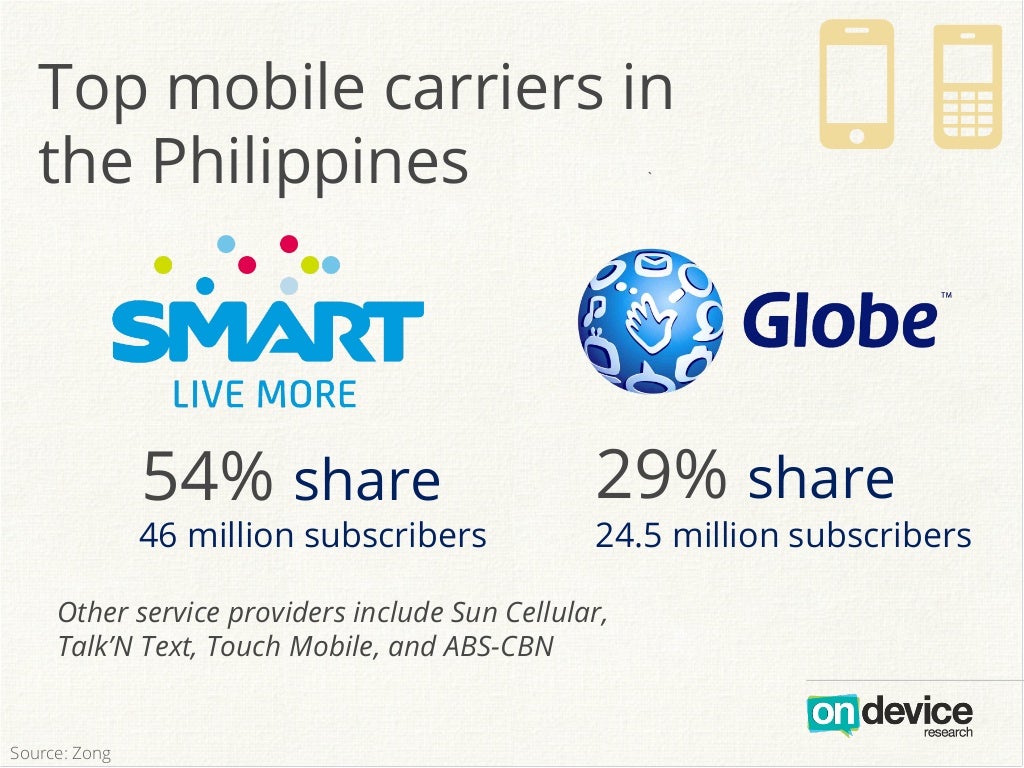
The two major network operators for mobile internet in the Philippines are Smart Communications and Globe Telecom, which combine to make a total of 83 percent of the market share. Sun Cellular is a distant third.

3G services
The roll out of the 3G network began in 2005 when the government opened bidding on five new 3G licences. Despite having five licences on offer, the NTC ultimately granted only four, as it argued that the remaining applicants lacked the capacity to effectively provide 3G services. The four successful companies included Globe Telecom, Connectivity Unlimited Resource Enterprise (CURE), Smart Communications (owned by PLDT), and Sun Cellular. Smart Communications, having acquired CURE in 2008, was itself acquired by PLDT in 2011. As a condition of the latter deal, PLDT agreed to relinquish its CURE licence.

Delays in spectrum allocation have been a drag on the region’s 3G uptake, which has been relatively slow. Low penetration of smartphones that are equipped for mobile broadband have also dampened growth.
All the same, growing data demand and the introduction of low-cost smartphones, such as the Nokia Lumina series unveiled in the Philippines in March 2014, paint a bright picture for the future of the industry.
LTE
Smart Communications was one of the first operators to introduce 4G LTE services in the Philippines. In August 2012, it launched LTE service at bands of 850 MHz and 2600 MHz, adding additional capacity at 1800 MHz the following month. These services are already available in larger cities such as Manila, Caloocan, Las Piñas, Makati, Quezon City, San Juan, and Valenzuela, according to Telegeography, a telecoms research firm.
The company is also set to expand this service further. In March 2014, it unveiled plans to extend its 4G LTE network to all major cities by the end of 2014 – areas including Bohol, Bacolod, Davao del Sur, Tagaytay and Ilocos Norte – thus reaching 50% of the population. In addition, the P32bn ($714m) of planned capital expenditures for 2014 will include expanding Smart Communications’ 3G coverage from its current coverage of 71% of the population to 100%.
Globe Telecom, too, is widening its networks. In November 2011, it launched a $790m programme to modernise its services, including the roll-out of a 4G LTE network in Makati, Manila, Pasig, Muntinlupa, Mandaluyong, Cebu City, Boracay and Quezon City. The company’s president and CEO, Ernest Cu, told OBG that the existing network infrastructure in the Philippines was built primarily to handle SMS traffic, which requires considerably less backbone capacity than data-intensive services. Now, in addition to expanding the company’s fibre optic network, Globe Telecom is seeking to standardise the communications protocols used for voice, SMS and data in order to further improve network capacity and help in future proofing the system. In 2014, capital investment in excess of $200m has been earmarked to further expand the data network and build additional capacity, which is becoming more important given high-end customers' growing mobile data needs.

Globe narrowly leads for LTE download speed, with an average speed of 6.1Mbps., slightly faster than Smart's 5.9Mbps. Internationally, however, both speeds are comparatively slow – with Australia ranked as the fastest country for LTE in the world, averaging 24.5Mbps earlier this year.

For upload speed the results are again very close, with Smart edging ahead of Globe with speeds of 7.2 Mbps. With speeds this close, as with the close download speeds above, most mobile users will not notice a significant difference unless they are downloading particularly large files, or using some other data-intensive service.


costofplans    

Smartphone penetration

The smartphone penetration rate in the Philippines is still at a low fifteen percent according to a recent study by On Device Research. That pales in comparison to the total mobile penetration in the country of 101 percent.Smartphone penetration in the Philippines is also the lowest of all the countries in Southeast Asia, including Malaysia (80 percent), Thailand (49 percent), and Indonesia (23 percent).

Smartphone penetration is expected to more than triple to 50 percent by 2015. Another positive: 88 percent of the total mobile internet population is below the age of 34. 

The battle for smartphone supremacy will be fought (and won) largely on price, given that 20 percent of the population lives on less than US$1.25 a day (54 PhP). For example, local brands Cherry Mobile, My Phone, and Star Mobile offer Android phones priced between US$50 and US$250 (2191 PhP to 10,958 PhP). This range is expected to be the sweet spot that will drive further adoption of smartphones.

International brands are also getting in on the action. Chinese brands Oppo and Xiaomi plan to expand into the Philippines, while Huawei is already offering their Ascend G6 to Filipinos. Priced at US$228 (9,994 PhP), which is half the cost of the previous model known as the P6, the Ascend G6 represents the Chinese firm’s bid to capture 10 percent of the market for mid-priced smartphones.


The race to be the cell phone brand that dominates the Philippine market is wide open. At the moment, Samsung leads at 43 percent. No other cell phone manufacturer has larger than a 10 percent market share. Sony and Cherry Mobile each have seven percent, Lenovo has five percent, and LG, Alcatel, and MyPhone each have three percent.

Samsunglead


The rising prevalence of smartphones will likely be the main driver of mobile revenues going forward, as consumers alter their preferences by reducing voice and SMS usage and increasing reliance on alternatives such Skype and instant messaging. While this may cause revenue losses with respect to these more traditional offerings, the wider range of data-driven services, such as applications, video-streaming and mobile gaming, will likely compensate over the longer term.

References: 


Wednesday, 30 April 2014

EE, O2, Three & Vodafone 4G: Which is best?

Which network is best value?
4G doesn't quite live up to the 60Mbps advertised speeds as we topped out at 40Mbps. Around congested urban areas like London you can expect speeds to average between 10 - 20Mbps.
Real-world results showed there was little to separate EE, O2 and Vodafone in terms of raw download speeds. Three was slightly slower but you can still expect 10Mbps+ in most areas.
The networks take a different approach to try and attract customers. EE focuses strengths like widespread coverage and consistent high-speeds. 
Three might not be the fastest but it is the cheapest and the only network which provides true all-you-can-eat data, so you don't need to worry about going over data limits. It is also the only network to allow you to use your allowance in the US, so if you're a frequent traveller this will prove invaluable.
O2 and Vodafone offer similar high-speeds and enticing add-ons. O2 offers subscriptions to Evernote and The Sun+, whereas Vodafone throws in access to Sky Sports Mobile or Spotify Premium.
Ultimately, it's going to depend on the reception. For many people in the UK, the only way to currently get 4G will be to sign up to EE as it offers coverage in areas other networks haven't reached.
Make sure you check every operator's coverage checker before signing up to a plan. Also take time to look at the benefits offered:
Recommendations:
EE - This is the network if you need the widest possible 4G coverage and consistent high-speeds and you're not too interested in add-ons.
O2 - Only if you live in or around one of the 13 big cities and you want access to discounts through the Priority Hub and  subscriptions to Evernote and The Sun+
Vodafone - Covers a third of the UK. This one is for sports or music fans as you get the choice between subscriptions Sky Sports Mobile and Spotify Premium. 
Three - Not the fastest, but the network of choice for those who don't want to be constrained by a data limit. Also allow you to use your allowance in the US.


Read more: http://www.itpro.co.uk/mobile/22048/ee-o2-three-vodafone-4g-which-is-best#ixzz31Ugt0IU2