Showing posts with label Vendor Samsung. Show all posts

Friday, 8 November 2019

Orange Romania Finally Launches 5G


Orange has entered the 5G fray with the launch of its first commercial network within its footprint, deploying the technology in three major Romanian cities. The operator launched 5G services in capital Bucharest, Cluj-Napoca and Iasi, with other Romanian cities to follow from 2020 onwards. At a launch event Ramon Fernandez, deputy CEO for Finance, Performance and Europe, explained the country was a natural choice to lead the operator’s 5G charge, having been a key part of its footprint since 1997. He also said the operator had invested “more than €3.5 billion” in its Romanian operations over the past 22 years.


Fernandez explained the operator deployed 115MHz of spectrum in the 3.4GHz to 3.6GHz bands, “more than double” the amount available to competitors. Orange stated the network offers peak download rates of 1.2Gb/s, with average rates of 600Mb/s.


Orange is the largest operator in Romania with 10.3 million connections according to GSMA Intelligence, just ahead of rival Vodafone’s 10 million.Vodafone and number four player Digi launched 5G earlier this year.

This launch and this network is the result of an attractive exclusive partnership with Samsung. An interesting partnership which works both ways. Samsung devices can only be sold by Orange, and Orange 5G tariffs can only be run through Samsung devices. It might sound unusual that two companies would want to limit this potential in this manner, but considering Orange is the market share leader for 4G (roughly 40%) while Samsung is the devices market share leader (estimates range between 50-55%), there are attractive gains for both parties.


The second interesting element of this announcement is the focus on Fixed Wireless Access (FWA). Orange has never been shy about its convergence ambitions, the success of bundling is evident in numerous markets but with no fixed assets in Romania it becomes difficult. There is a wholesale agreement in place with Telecom Romania, however this is far from an ideal position.

With 5G, FWA becomes a much more apparent opportunity to compete with the fibre services which are being offered by competitors. It certainly isn’t perfect by any means, but if Orange can deliver the promised gigabit speeds over the air, there will certainly be demand from increasingly speed obsessed consumers.

The final interesting aspect of this story could count against the Orange. After performing a number of speed tests across Bucharest, it became very apparent, very quickly, that the 4G network is excellent (60-96 Mbps), providing speeds which even the most demanding consumer could not make use of. In delivering such eye-watering speeds over 4G, one should ask whether this weakens the selling point of 5G. As attractive as 1.2 Gbps download speeds are, who actually needs that much power right now?

Despite the number of features and wild promises here, the success of Orange Romania in the 4G era might undermine the pursuit of early adopters for 5G. This is a difficulty which only remains while the operators discuss little more than speed upgrades, though as the ecosystems develop new services will be pushed at the consumer.


Further Reading:

Tuesday, 6 August 2019

Orange Romania Continues 5G Testing with Samsung


According to a recent Samsung announcement:

Samsung Electronics and Orange Romania have successfully deployed a 5G New Radio (NR) network to demonstrate a series of 5G use cases at Untold Festival 2019, the largest annual dance music festival in Romania, held from August 1 to August 4.

The two companies started their 5G collaboration in 2018 with a 5G Fixed Wireless Access (FWA) trial in Cluj county, Romania, where Orange mobile customers became the first European users to experience at home 5G services. Now, the companies are ramping up their efforts to bring the benefits of 5G to users in Romania.

At Untold, which drew over 335,000 attendants last year, Orange Romania and Samsung have set up 5G use cases to offer immersive experiences powered by the 5G network’s ultra-low latency and ultra-high speed, unfolding the potential of the next generation technology for all to see. The demonstrations include real-time streaming of the performances, captured by 360-degree cameras built onto the arena’s main stage. The stream is shown at an Orange VR zone set up outside the arena, providing a uniquely immersive viewing experience to fans who visit. The companies are also holding an event demonstrating 5G download speeds reaching above 1Gbps, with a latency reduction of 50% on that experienced when using current LTE technology.

“With these successful demonstrations, we are showcasing the experiences that 5G can bring to Orange customers in Romania,” said Emmanuel Chautard, Chief Technology Officer at Orange Romania. “Together with Samsung, we’re showing live network capabilities, with proof that goes beyond just impressive speeds more centered on the customer experience.”

“5G offers more than just a faster connection; it enables transformative use cases that will benefit people and businesses across the industry,” said GY Seo, Senior Vice President and Head of Global Sales & Marketing, Networks Business at Samsung Electronics. “These joint demonstrations allow for a glimpse into the new kinds of services and capabilities that will be made possible as we unlock the potential of 5G for users across Europe.”

The trial at Cluj Arena, where the festival is taking place, makes use of Samsung’s latest solutions, including 5G Massive MIMO Units (MMUs), which support the 3.4-3.8GHz frequency band. Samsung 5G MMUs have already been rolled out across Korea by all three Korean 5G operators for use with their 5G commercial service, which launched in April of 2019. This commercially proven MMU is one of the smallest and lightest in the industry, making installation in existing cellular sites very straightforward.

Here is a video from Orange Romania


Last year at around this time, Orange Romania was in news for doing the first European 5G multi-vendor Fixed Wireless Access (FWA) test

According to 5G Observatory Quarterly Report #4 (June 2019), the Spectrum situation in Romania is as follows:

The National Authority for Management and Regulation in Communications (ANCOM) launched a public consultation on 5G spectrum between May and June 2018. 

ANCOM launched a public consultation on the “National Strategy for the Implementation of 5G in Romania” between November 20th and December 21st, 2018.

In December 2018, the Romanian regulator, ANCOM, has issued a consultation about its action plan for 2019. ANCOM’s President, Sorin Grindeanu, said in a press release that its main project will be the auction of the 700 MHz, 800 MHz, 1500 MHz, 2.6 GHz, and 3.4 – 3.6 GHz bands for 5G services.

Spectrum in 700 MHz and 3.4-3.8 GHz frequencies could be auctioned in 2019/2020 and 26 GHz spectrum in 2021. 

In Romania, while Orange and Telekom plan to launch 5G in 2020, Vodafone launched 5G back in May and Digi launched 5G in July.

Related Posts:


Thursday, 28 March 2019

SK Telecom achieves 3.9 Gbps in tests by triple-coupling of 5G, LTE and Wi-Fi

Earlier this month we wrote about how "SK Telecom & Samsung performs 5G EN-DC tests, achieve 2.65 Gbps". We also explained this is mainly because of the large bandwidths available to each of the South Korean operator.

In another news (in Korean only), SK Telecom announced that they have achieved up to 3.9 Gbps by triple connectivity (triple-coupled or triple-aggregation) between 5G, LTE & Wi-Fi


The press release says (using Google translate):


* [5G-LTE-WiFi 3-Step Coupling Technology 'following' 5G-LTE Coupling '] Fastest 4Gbp
* Applied '5G media compression technology' to reduce media data consumption by more than 30%

SK Telecom has completed the key test for mass production of "Galaxy S10 5G" on 25th, followed by 2.7Gbps class 5G + LTE combination technology and "quantum cryptography" network.

For the past two months, SK Telecom has tested thousands of items including '5G Device Test Lab' in Bundang's office building, and interoperability testing between 5G network and smartphone, interface verification, and frequency compatibility at commercial sites. We also made a scenario-specific test by creating more than 100 virtual environments using special equipment in the laboratory.

'5G device test lab' and commercial network performance test is required to be able to launch the smartphone formal. This is why the process is called the final gateway to commercialization. With the completion of the core test, the launch of the world's No. 1 5G smartphone is expected to be smooth.

In the next step, SK Telecom will conduct a delivery inspection this week for mass-produced products produced at factories. The company plans to make its first launch of the 5G smartphone without any problem.

In addition, SK Telecom is preparing to hire a new 5G technology such as '5G Media Compression Technology' to reduce data consumption and 'Galaxy S10 5G'.


"5G-LTE-WiFi 3-stage coupling technology" is followed by "5G-LTE combining technology"

SK Telecom succeeded in verifying '5G-LTE combining technology' that speeds up to 2.7Gbps on November 11, and it was installed first in 'Galaxy S10 5G'.

Furthermore, SK Telecom implemented the "Triple Aggregation", which uses ▲ 5G ▲ LTE ▲ Wi-Fi for data transmission at the same time, in the Galaxy S10 5G, and completed the verification in the 5G commercial network.

The 'three-tier technology' allows users to download content or applications up to 3.9 Gbps in areas where three networks are simultaneously deployed. In just 4 seconds you can get a movie (2GB) on the other hand.

SK Telecom has upgraded Multi-Path TCP (MPTCP), a technology that connects LTE and Wi-Fi, and implemented the '3-step combining technology' preemptively to the Galaxy S10 5G.
...


Some people are quick to point out the different strategies by different South Korean operators. Dual connectivity means higher speeds but higher latency too while standalone will means lower latency and maybe lower data rates initially.

As we have pointed out, the South Korean operators have already got large amounts of 5G spectrum so speeds will be no issue in long run.

Tuesday, 26 March 2019

KDDI and Samsung Strengthen their 5G Partnership

Samsung and KDDI have been working together since 2005. Back in 2015 they signed MOU for joint development of 5G technologies. Since then they have done quite a few joint demonstrations like:

  1. 5G Handover Using 28GHz Spectrum on a City Highway in Tokyo
  2. High-Speed 5G Mobility Test (Video)
  3. Demonstration of 5G on a Train Moving at 100km/hour
  4. 5G field trial held in Okinawa Cellular Stadium using Samsung’s end-to-end 5G solutions

Back in January, both the companies announced couple of other interesting joint trials

Real Time 4K Video Communication Powered by 5G at a Japanese Train Station
Samsung and KDDI Demonstrate Real Time 4K Video Communication Powered by 5G at a Japanese Train Station

Together with Waseda University, Keihin Corporation, and Advanced Telecommunications Research Institute International (ATR), Samsung demonstrated effective communications through 4K UHD video using a 28GHz band 5G base station to enhance passenger safety in Tokyo.

The demonstration was conducted from November 21 to December 21, 2018 at the Haneda Airport International Terminal in Ota, Tokyo. As the number of incoming visitors is steadily increasing, Samsung and KDDI have been working on the real-world scenario, powered by 5G, to make their travels safer and more convenient.

During the demonstration, the video files collected from both 4K security cameras and security robots patrolling the station were sent via tablets using 5G. Then, the files were received by the base station to be displayed on the monitor and VR goggles in the monitoring room. Moreover, detecting any suspicious people or objects at the station was all possible through collecting and analyzing the received 4K files shown on the server.

Samsung’s 5G solutions were used to conduct the demonstration. KDDI was responsible for assessing and designing the 5G test environment at the train station, which was provided by Keikyu Corporation, while Waseda University provided the monitoring system, VR goggles and video evaluation.


Next-generation technology enhances classroom activities with ultra-high-definition video, providing an immersive educational experience for students


Samsung Electronics and KDDI announced the successful demonstration of their 5G capabilities by working with the Advanced Telecommunications Research Institute International (ATR) to deploy ultra-fast communications at Maehara Elementary School in Tokyo. For the first time in Japan, 5G was utilized to help students download contents in class using UHD, powered by the infrastructure of next-generation technologies.

The demonstration, made possible by Samsung’s 5G solutions, was conducted from November 21 to December 12, 2018 at the gym inside Maehara Elementary School. In order to showcase 5G capabilities, the gym was set up with Samsung’s 5G network using a 28GHz band to enable transmission of UHD videos in a school setting. The demo involved comparing the difference between 5G tablets and Wi-Fi tablets in their ability to download and play back videos.

During the demonstration, students were given a chance to create their own videos and experience high-speed and large capacity transmission of large video files. In doing so, they verified the capabilities of 5G for this type of use case. KDDI was responsible for assessing and designing the 5G areas used in the trial and ATR provided the testing infrastructure.

Leveraging 5G will enhance various classroom activities and ultimately offer a whole new academic experience to students and teachers. During the Samsung and KDDI demonstration, large UHD videos were transmitted without interruption, despite requiring large amounts of bandwidth. This allowed the children to enjoy a seamless connection while engaging with the contents.

Sunday, 17 March 2019

SK Telecom & Samsung performs 5G EN-DC tests, achieve 2.65 Gbps

South Korean MNO SK Telecom and Samsung Electronics has announced that they have successfully completed the network device interoperability test applying Dual Connectivity technology using both 4G and 5G networks provided by Samsung’s Networks Business, a.k.a. ‘E-UTRAN New Radio Dual Connectivity (EN-DC)’ based on the 3GPP Release-15 5G New Radio (NR) standard.

Before proceeding further, if you are not aware of different 5G Network Architecture Options (including EN-DC), you may want to check out our tutorial on 3G4G page here.


According to the Samsung press release:

During the test, both companies have successfully achieved 2.65Gbps in data speeds on the 5G smartphone, combining both 1.5Gbps in 5G using 3.5GHz frequency (100MHz bandwidth) with 1.15Gbps in LTE using 1.8GHz, 2.1GHz, and 2.6GHz frequencies (65MHz bandwidth) all of which are for commercial use by SK Telecom.

The test, carried out at Samsung Electronics located in Suwon, Korea, used Samsung’s commercial 4G and 5G NR end-to-end networks solutions which have been provided to the operator’s current service. In addition, companies used Samsung’s virtual core (vCore) that supports simultaneous 4G and 5G as well as its Galaxy S10 5G, Samsung’s first 5G smartphone which was unveiled last month.

SK Telecom, in particular, will be able to boost the overall transmission data speed by 80% by leveraging the 4G and 5G dual connectivity. It will allow users who are staying in the 5G service coverage to download UHD videos of 2GB in just 6 seconds, and large video content such as 4K VR video of 10GB in less than 30 seconds.

The two companies demonstrated the delivery of multi-gigabit speeds for 5G device, with a focus on seamless user experiences. Wherever mobile service subscribers are without being limited to 4G or 5G service areas, they can expect seamless, consistent, and stable mobile services. In the early stages of 5G era, the combined capabilities of 4G and 5G networks are important forces for mobile carriers to maximize the characteristics of the 5G network – ultra-fast speed, low-latency, and massive-connectivity by leveraging widely deployed 4G network coverage.

The success of the demonstration by SK Telecom and Samsung signifies a blueprint of early 5G deployment, spotlighting a rapid, stable and effective path to 5G service using a dual 4G and 5G approach.

This success is part of an ongoing collaboration between SK Telecom and Samsung of many years. Pushing forward early 5G commercialization, the companies have succeeded in the world’s first 4G and 5G interworking back in 2017 and world’s first 5G Next-Generation Core (5G NC) trial in June 2018, which featured control and user planes separation and VNFs implementation based on 3GPP release 15 standard. These joint forces have led Samsung to become a major partner for SK Telecom to successfully launch 5G mobility commercial service in Korea, December 1st 2018.


Related posts:


Monday, 26 November 2018

South Korea Telcos: United in 5G Launch


South Korea has ambitions to be the first country to roll-out 5G and their three major mobile operators will work together to launch 5G networks at the same time in 2019 to “avoid excessive competition” and ensure the country is the first to launch the next-generation technology. This is discounting the fact that San Marino already launched nationwide 5G but its just a city state and the 5G launch does not really qualify to be considered a nationwide launch

SK Telecom, KT and LG Uplus have agreed to jointly introduce 5G services on “Korea 5G Day”, which is likely to be sometime in March 2019.

The South Korean government in April of this year mandated that operators collaborate on 5G deployments by sharing core fibre infrastructure, rather than RANs, in a bid to reduce the cost of rolling out the technology and so enable operators to pass on the savings to customers.

The triumvirate of mobile carriers plan to provide 5G services using mobile routers providing mobile connections for Wi-Fi devices, first rather than smartphones. The services on smartphones will be available a month later.

In an interview with The Korea Times, ICT Minister Yoo Young-min stressed the need for the government and companies to closely cooperate to reach the goal:

"The world's first 5G commercialization is very meaningful in that Korea will have an advantageous position in the global market and take the leadership. Amid intensifying competition among global mobile carriers, it is significant for the government and companies to join hands and reach the goal together."

There has been much speculation and discussion on who would be chosen to supply the 5G network equipment.

KT has chosen Samsung Electronics, Ericsson and Nokia. As expected, Huawei was excluded from the list. They elaborated:

“In choosing 5G equipment providers, the company considered a wide range of factors: the level of technology, investment costs and management stability based on the compatibility with the existing LTE network.”

SK Telecom named Samsung Electronics, Ericsson and Nokia as its 5G equipment providers. SK Telecom have recently opened one of their first commercial fifth-generation base stations in the central area of Seoul. Using equipment manufactured by Samsung Electronics, SKT introduced a 24-kilogram rectangular active antenna unit for the 3.5-gigahertz frequency band -- 1 meter in height and 23 centimeters in width -- installed at the rooftop of a small hotel building in Myeong-dong, one of the most crowded areas in Seoul. Compared to the fourth-generation Long Term Evolution antenna units hung at the rooftop railing, the 5G antenna unit consisting of a total of 32 individual antennas looked noticeably smaller and more compact, requiring just 10 square-meters of space for installation. 


Huawei was also excluded by them for the second time now despite having participated in internal tests along with the three selected.

SKT and KT’s choices were anticipated because both had used equipment from Samsung, Ericsson and Nokia for their 4G LTE networks.


LG U+ is the only one among Korea’s three mobile carriers that has not yet announced 5G equipment suppliers. The smallest mobile carrier is likely to include Huawei on its list. It partnered with the Chinese company for its 4G LTE network, along with Samsung, Ericsson and Nokia.

The biggest advantage of Huawei’s 5G equipment is cost efficiency. The Chinese company is known to charge prices that are 20 to 30 percent lower than other global competitors for high-quality 5G equipment. However the major issue with Huawei are the security concerns.
Due to its ties to the Chinese government, there have been worries that the company’s equipment may be used for spying. In August of this year, the U.S. and Australian governments banned Huawei from supplying equipment for their 5G wireless infrastructure citing security reasons. Britain said in July it “is less confident” about the integrity of Huawei products.

Huawei has been denying such allegations.

In a press release last month, the Chinese tech company highlighted that, despite ongoing security concerns, there has been zero cases of actual information leakage in the past.

Samsung is aiming to control 20 percent of the global market for 5G network equipment in 2020, the head of the company's network business has said. Samsung Electronics President Kim Young-ky claimed that the company is not a newcomer to the network equipment industry as it has been supplying products in this field for the past 20 years. According to the data compiled by industry tracker Dell'Oro, Samsung Electronics took up 11 percent of the global market for fourth-generation (4G) network equipment in the second quarter of this year.


Related Posts:

Tuesday, 4 September 2018

Orange Romania: 1st European 5G multi-vendor Fixed Wireless Access (FWA) test


According to The Mobile Network Magazine:

Orange has been trialling 5G Fixed Wireless Access (FWA), using the 5GTF specifications, with live customers in Romania. It is the first such trial in Europe, although other trials of the same radio access technology are much more advanced in the USA with Verizon, Sprint and AT&T.

Orange sees FWA as a likely use case for 5G in markets where fibre and fixed broadband availability is constrained. It said that in Romania it could see potential for up to 10% of the overall broadband customer base to have a FWA connection

In Floresti, Orange has two Samsung Fixed Wireless Access points operating over 500MHz of experimental 26GHz spectrum. The access points have 128 element MIMO antennas. Orange has one access point on a tower on top of a hill and one on a lower, 20m, tower. The trial runs from the start of June to mid July.

About 30km away in an Orange data centre the operator has sited vBBU capacity from Samsung on COTS server hardware, and a dedicated Virtual Core from Cisco. Arnaud Vamparys,  Orange Senior VP Radio Networks, said the operator would not necessarily deploy vRAN to support FWA deployments, but that it was important to do so in this instance to explore the potential flexibility and efficiency benefits that such an architecture could support. “We are not saying that FWA will be on virtual radio, but we are doing it in the beginning because it is important to understand the choice.” The operator had deployed a high layer split between the access point and vBBU, he added.

More details are available in TMN mag. Below is the official video about the FWA testing.


Further Reading:

Saturday, 14 July 2018

Verizon's 5G Progress & Plans


Verizon plans to launch 5G in at least 4 cities this year, two that have already been announced being Sacramento and Los Angeles. This information is based on Lowell McAdam, Verizon chairman and CEO, speaking to CNBC's David Faber back in May.

Their intention is still to use millimeter wave bands (mmWave) in 28GHz and do a Fixed-wireless access (FWA). Lowell McAdam referred to this as ultra-wideband 5G as he says there will be different flavors of 5G.

The videos (playlist) below shows some of the trials and applications and the first video is particularly interesting as it tries to dispel the myths associated with mmWave bands.


Verizon have publicly announced that they are doing trials with Samsung, Ericsson and Nokia. According to Light Reading, Samsung is supplying the gear for Verizon's fixed 5G network in Sacramento, Calif., while Ericsson's equipment will be used in Los Angeles, the only two markets announced so far.

We will see Nokia equipment being deployed in another city soon as its being heavily promoted by their marketing department and rightly so.

Verizon is also working with innovative universities, start-ups and other companies to develop the use cases that will run on tomorrow’s 5G networks. At Alley, site of Verizon’s 5G incubator, five of these innovators are getting to use real 5G technology to develop, refine and demonstrate ways 5G networks will change the ways we live, learn, work and play.

We are looking forward to seeing real world results after the services are launched on Q4 2018.

Further Reading:

Friday, 24 October 2014

Country Overview: The Philippines


With the second-largest population in South-east Asia after Indonesia, the Philippines has a large consumer base for its mobile market. Penetration in 2012 reached 106%, or 102.3m subscribers, according to a report by PwC. Filipinos are also among the world’s most prolific texters, accounting for 10% of global SMS messages.

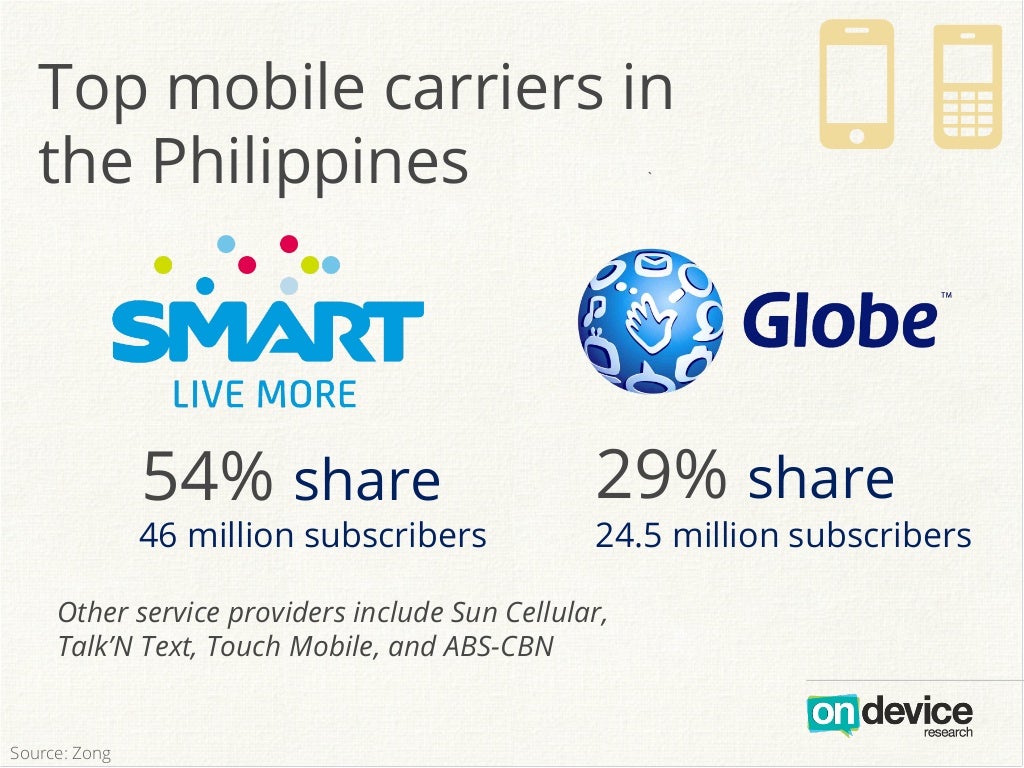
The two major network operators for mobile internet in the Philippines are Smart Communications and Globe Telecom, which combine to make a total of 83 percent of the market share. Sun Cellular is a distant third.

3G services
The roll out of the 3G network began in 2005 when the government opened bidding on five new 3G licences. Despite having five licences on offer, the NTC ultimately granted only four, as it argued that the remaining applicants lacked the capacity to effectively provide 3G services. The four successful companies included Globe Telecom, Connectivity Unlimited Resource Enterprise (CURE), Smart Communications (owned by PLDT), and Sun Cellular. Smart Communications, having acquired CURE in 2008, was itself acquired by PLDT in 2011. As a condition of the latter deal, PLDT agreed to relinquish its CURE licence.

Delays in spectrum allocation have been a drag on the region’s 3G uptake, which has been relatively slow. Low penetration of smartphones that are equipped for mobile broadband have also dampened growth.
All the same, growing data demand and the introduction of low-cost smartphones, such as the Nokia Lumina series unveiled in the Philippines in March 2014, paint a bright picture for the future of the industry.
LTE
Smart Communications was one of the first operators to introduce 4G LTE services in the Philippines. In August 2012, it launched LTE service at bands of 850 MHz and 2600 MHz, adding additional capacity at 1800 MHz the following month. These services are already available in larger cities such as Manila, Caloocan, Las Piñas, Makati, Quezon City, San Juan, and Valenzuela, according to Telegeography, a telecoms research firm.
The company is also set to expand this service further. In March 2014, it unveiled plans to extend its 4G LTE network to all major cities by the end of 2014 – areas including Bohol, Bacolod, Davao del Sur, Tagaytay and Ilocos Norte – thus reaching 50% of the population. In addition, the P32bn ($714m) of planned capital expenditures for 2014 will include expanding Smart Communications’ 3G coverage from its current coverage of 71% of the population to 100%.
Globe Telecom, too, is widening its networks. In November 2011, it launched a $790m programme to modernise its services, including the roll-out of a 4G LTE network in Makati, Manila, Pasig, Muntinlupa, Mandaluyong, Cebu City, Boracay and Quezon City. The company’s president and CEO, Ernest Cu, told OBG that the existing network infrastructure in the Philippines was built primarily to handle SMS traffic, which requires considerably less backbone capacity than data-intensive services. Now, in addition to expanding the company’s fibre optic network, Globe Telecom is seeking to standardise the communications protocols used for voice, SMS and data in order to further improve network capacity and help in future proofing the system. In 2014, capital investment in excess of $200m has been earmarked to further expand the data network and build additional capacity, which is becoming more important given high-end customers' growing mobile data needs.

Globe narrowly leads for LTE download speed, with an average speed of 6.1Mbps., slightly faster than Smart's 5.9Mbps. Internationally, however, both speeds are comparatively slow – with Australia ranked as the fastest country for LTE in the world, averaging 24.5Mbps earlier this year.

For upload speed the results are again very close, with Smart edging ahead of Globe with speeds of 7.2 Mbps. With speeds this close, as with the close download speeds above, most mobile users will not notice a significant difference unless they are downloading particularly large files, or using some other data-intensive service.


costofplans    

Smartphone penetration

The smartphone penetration rate in the Philippines is still at a low fifteen percent according to a recent study by On Device Research. That pales in comparison to the total mobile penetration in the country of 101 percent.Smartphone penetration in the Philippines is also the lowest of all the countries in Southeast Asia, including Malaysia (80 percent), Thailand (49 percent), and Indonesia (23 percent).

Smartphone penetration is expected to more than triple to 50 percent by 2015. Another positive: 88 percent of the total mobile internet population is below the age of 34. 

The battle for smartphone supremacy will be fought (and won) largely on price, given that 20 percent of the population lives on less than US$1.25 a day (54 PhP). For example, local brands Cherry Mobile, My Phone, and Star Mobile offer Android phones priced between US$50 and US$250 (2191 PhP to 10,958 PhP). This range is expected to be the sweet spot that will drive further adoption of smartphones.

International brands are also getting in on the action. Chinese brands Oppo and Xiaomi plan to expand into the Philippines, while Huawei is already offering their Ascend G6 to Filipinos. Priced at US$228 (9,994 PhP), which is half the cost of the previous model known as the P6, the Ascend G6 represents the Chinese firm’s bid to capture 10 percent of the market for mid-priced smartphones.


The race to be the cell phone brand that dominates the Philippine market is wide open. At the moment, Samsung leads at 43 percent. No other cell phone manufacturer has larger than a 10 percent market share. Sony and Cherry Mobile each have seven percent, Lenovo has five percent, and LG, Alcatel, and MyPhone each have three percent.

Samsunglead


The rising prevalence of smartphones will likely be the main driver of mobile revenues going forward, as consumers alter their preferences by reducing voice and SMS usage and increasing reliance on alternatives such Skype and instant messaging. While this may cause revenue losses with respect to these more traditional offerings, the wider range of data-driven services, such as applications, video-streaming and mobile gaming, will likely compensate over the longer term.

References: