Showing posts with label Operator Reliance Jio. Show all posts

Sunday, 25 August 2019

Jio Makes Another Set of Extremely Bold Announcements

Reliance Jio certainly knows how to stay in news, not just because of clever marketing but because of its extremely bold initiatives that is starting to make not just their competitors nervous but other industries like the cinemas, ISPs, cable companies, etc.

In the latest annual general meeting (AGM - video embedded below), their Chairman and Managing Director, Mukesh Ambani made some very interesting announcements. The complete statement is available here but here are the main points (from the report - note the CAPS is as shown in the report, not emphasized by me but the bold is by me):


  • JIO's customer base has crossed 340 million users and they are signing up more than 10 million new customers EACH MONTH.
  • The core and aggregation layers of our converged network have been 5G ready since day one
  • Jio is now Ready to kickstart FOUR more engines of CONNECTIVITY REVENUE for Jio.
    • INTERNET OF THINGS or IoT all over India.
      • JIO has developed an innovative service on its pan-India 4G network called Narrowband Internet-of-Things or NBIoT, for short.
      • Within another 2 years, it is estimated that there will be more than 2 Billion Connected IOT devices in India
      • Jio aims to connect at least 1 BILLION of these on JIO's IoT platform
      • This translates into a ₹20,000 CRORE PER YEAR revenue opportunity for JIO.
      • Jio's IoT platform will be commercially available starting 1st January, 2020.
    • HOME BROADBAND.
      • Jio Fiber, currently in preview phase with 500,000 users but will launch commercially on September 5.
      • The trial homes on average are consuming more than 100 GBs per month and this usage is increasing with each passing day.
      • Jio has drawn up a plan to reach 20 million residences and 15 million business establishments in these 1,600 towns
      • The company will offer plans from ₹700 ($10) to ₹10,000 ($140) with speeds up to 1Gbps.
      • You get a landline phone connection, at no additional cost.
      • And you get a DIGITALSET-TOP-BOX that opens up unparalleled digital experiences within your home
      • ULTRAHIGH DEFINITION ENTERTAINMENT
      • VIRTUAL REALITY content
      • MULTI-PARTY VIDEO CONFERENCING
      • VOICE-ENABLED VIRTUAL ASSISTANTS
      • INTERACTIVE GAMING
      • HOME SECURITY
      • and many other SMART-HOME SOLUTIONS
      • JIO SET-TOP-BOX to accept the broadcast cable TV signals from our LCO (Local Cable Operators) partners.
    • BROADBAND for SMALL AND MEDIUM BUSINESSES.
      • JIOFIBER enables a powerful combination of FIXED-LINE CONNECTIVITY and CLOUD APPLICATIONS leapfrogging them from NO TECHNOLOGY to having a complete line-up of cutting-edge, plug-and-play technology enabled tools.
    • (Large) ENTERPRISE BROADBAND.
      • Today cloud-based solutions provide out-of-the-box capabilities which are easier, faster and cheaper to adopt. JIOFIBER and JIO's cloud solutions level the playing field for Indian enterprises enabling them to accelerate their digital transformation and compete globally using the very same technologies that are used by global majors.
  • JIOFIBER plan STARTS WITH 100 Mbps speed and we have plans all the way up to 1 Gbps or 1000 Mbps, plans will be priced between ₹700 to ₹10,000 per month to suit every budget and every need.
    • Landline voice calls from home to any Indian operator - mobile or fixed - will be absolutely free forever.
    • Bundled landline service will let them call any network in the country for free.
    • Unlimited free calls to the US and Canada for ₹500 ($7) per month.
  • JIOFIBER plans will come BUNDLED with subscriptions to most leading premium OTT applications.
    • Premium JIOFIBER customers will be able to watch movies in their living rooms the same day these movies are released in theatres! This is called JIO FIRST-DAY-FIRST-SHOW. Jio plans to launch this service in the middle of 2020.
  • A special mobility service for our JioFiber users called JIO POSTPAID PLUS, to deliver a platinum-grade service and product experience.
    • India's first priority SIM-setup service at home, where your connection will be moved to Jio by visiting your home.
    • Seamless Data and Voice Connectivity across all your devices, both at home and outside.
    • Unprecedented Family plans – one data plan for better control on GBs and sharing within your family.
    • International roaming at a fraction of a cost with superior service experience
    • Phone upgrades at preferential rates
    • All your home solutions on your phone.
  • JIOFIBER customers who opt for our annual plans which we call JIO-FOREVER plans, will get an HD OR 4K LED TELEVISION and a 4K SET-TOP-BOX ABSOLUTELY FREE. We are calling this the JIOFIBER WELCOME OFFER.
  • JIO is already a software company.
    • JIO has over 6000 software engineers and we are continuing to attract technology talent from across India and the world.
    • JIO is also investing in a growing ecosystem of technology startups.
  • Blockchain technology all over India: Using Blockchain, we also have an opportunity to invent a brand-new model for data privacy where Indian data especially customer data is owned and controlled through technology by the Indian people and not by corporates, especially global corporations. Data is wealth and Indian wealth must remain in India
    • Over the next 12 months, JIO will install across India one of the largest blockchain networks in the world with tens of thousands of nodes operational on day one.
  • Edge computing and Virtual and Mixed Reality content: Delivering immersive content to hundreds of millions of users requires a well-integrated solution spanning connectivity, data storage and real-time computing. And we need to deploy such solutions at the edge of the network or in other words, closer to where our users are.
    • JIO is setting up a pan-India Edge Computing and Content Distribution network again starting with tens of thousands of nodes.
    • This means that your favourite content and applications will be even nearer to you. So even faster downloads and faster response times.
  • CLOUD INFRASTRUCTURE across India: To leapfrog the world, it is a national imperative to develop a nation-wide cloud computing infrastructure that is both cutting-edge and affordable. Jio and Microsoft have entered into a globally unique long-term alliance to accelerate the digital transformation of our country. 
    • As part of this alliance, while Jio sets up a network of large world-class datacenters across India, Microsoft will bring its Azure cloud platform into Jio's datacenters. 
    • When we put these two pieces together, we now have the capability to develop truly India-native solutions including Speech Recognition and Natural language understanding for all major Indian languages and dialects.

As a result of the announcements, Reliance shares went up 12% in biggest intraday rise in decade; Airtel and Vodafone shares dipped. Some cinemas have been unnerved by Reliance Jio offer, leading multiplex companies hit back saying that they will not screen films that are released on OTT simultaneously.


A fact that was announced during the demo was that the amount of fiber already laid by Jio can circle the earth 11 times.

Here is the complete AGM video


Related Posts:

Monday, 22 April 2019

Reliance Jio Announces Progress, Amid Decreasing ARPU

Back in October we wrote about Jio reaching 250 million subscribers, now it has announced over 300 million subscribers up to March 2019. In fact their Q4 financial results summarises the results nicely, as can be seen in the picture below.

In summary:

  • Total subscriber base stands at 306.7 million
  • ARPU ₹126.2 (roughly US $1.8)
  • Average data consumption 10.9 GB/ user/ month.
  • Wireless Data Consumption across network was 956 crore GB (9560 Petabytes) during the quarter 
  • Average Voice 823 minutes of VOLTE voice/ user/ month
  • Jio network carried ~71% of 4G data traffic in India during CY18

One of the strategies that Jio has adopted is to bring connectivity to even the most remote locations. In a way they are forced to do this as they do not have legacy networks and rely on VoLTE for voice. VoLTE only works reliably with a proper 4G coverage.

In addition to providing voice & data, Jio is bringing unique Apps for not just keeping customers updated and in-control of their package, service and spending but also entertainment which is a must have nowadays for any service to succeed. Smart feature phones using KaiOS is letting them bring new users who are too reluctant to transition to smartphones.


OpenSignal report on India Mobile Network Experience, April 2019 pointed out that:

The story of Jio's network expansion is remarkable. Jio has been a fully-fledged 4G operator for less than three years, but has completely disrupted the market with its rapid network rollout and unlimited data plans. In our first report on the India market two years ago, Jio scored an outstanding 91.5% 4G Availability. Six months later the operator had passed the 95% mark, and its score has been steadily growing ever since.

To put this in context, Jio's winning 4G Availability score of 97.5% is the highest we have ever recorded at country level in any of our reports. In the U.S., two operators have scored over 90%, while in Taiwan four are over this mark — but none in either market have yet passed 95%. Even in the Netherlands, arguably Europe's most advanced mobile market, all the operators have 4G Availability scores over 90%, but only one has passed 95% — and only just, reaching 95.2% — while Japan has two operators over this benchmark. In a country with the sheer geographical size and population base of India, where the landscape ranges from huge cities to high mountains and vast agricultural plains, Jio's achievement of reaching 97.5% 4G Availability in such a short time is truly astonishing.

Jio has themselves committed to achieve all-IP 4G LTE network population coverage of 99% shortly. We will wait and see when this will happen but in the meantime, Reliance Jio has plenty to celebrate.

Sunday, 27 January 2019

World's largest mobile networks by subscriber numbers - Jan 2019

Here is a list of top 10 mobile networks by subscribers. The list is very dynamic as some operators grow while others shrink. The best example of operator that has been growing rapidly, overtaking others is Reliance Jio.


1. China Mobile, China, 925 million [1]

2. Vodafone Group, UK, 536 million [6]
Note: Vodafone Idea, India has 422 million subscribers [2]

3. Bharti Airtel Group, India, 413 million [4]
Note: Airtel India has 329 million subscribers [3]

4. China Unicom, Hong Kong, 315 million [1]

5. China Telecom, China, 303 million [1]

6. Reliance Jio, India, 280 million [6]

7. América Móvil Group, Mexico, 279 million [5]

8. Telefónica Group, Spain, 272 million [7]

9. MTN Group, South Africa, 221 million [9]

10. Veon Group, Netherlands, 211 million [8]
10. Orange Group, France, 211 million [10]*

* = added later

[1] https://www.mobileworldlive.com/asia/asia-news/china-telecom-narrows-subs-gap-to-unicom/
[2] https://discover.vodafone.in/about-us/home?section=consumer
[3] https://www.airtel.in/about-bharti/equity
[4] https://www.airtel.in/about-bharti/about-bharti-airtel?icid=footer
[5] http://q4live.s22.clientfiles.s3-website-us-east-1.amazonaws.com/604986553/files/doc_financials/quarterly/2018/3Q18.pdf
[6] https://www.mobileworldlive.com/asia/asia-news/jio-profit-surges-on-continued-subs-gains/
[7] https://www.telefonica.com/en/web/shareholders-investors/financial_reports
[8] https://veon.com/Global/Files/Reports/3Q18/Q3%202018-Full%20announcement.pdf
[9] https://www.mtn.com/MTN%20Service%20Detail%20Quarterly%20Quarterly%20Trading%20Upd/MTN_Q12018_Results.pdf
[10] https://rai2017.orange.com/orange2017-content/uploads/2018/05/orag_1802135_ra_150x210_gb_mel.pdf

Thursday, 25 October 2018

The Rise of Reliance Jio Continues as it Acquires Over 250 Million Subscribers


Reliance Jio announced last week that it has crossed 250,000,000 subscribers. The following are some of the highlights from the announcement (emphasis mine):

  • Jio has accelerated its pace of subscriber additions further with net addition during the quarter of 37.0 million (as against 28.7 million in the previous quarter), highest in any quarter since the launch of commercial services
  • Gross adds at 41.7 million and churn of 4.7 million implying the lowest industry churn rate at 0.66% per month
  • Customer engagement continued to grow with average data consumption per user per month of 11.0 GB and average voice consumption of 761 minutes per user per month
  • Video consumption drove most of the usage, increasing to 410 crore hours per month on the network; average video consumption of 17.5 hours per subscriber per month
  • Further deepening of all-IP 4G LTE network in existing areas along with coverage expansion to 99% of population is on track to be completed in FY19
  • Only network to deploy tri-band (800MHz/ 1800MHz/ 2300MHz) pan-India 4G
  • World’s largest mobile data consumption network which is 5G ready
  • World’s largest VOLTE network, with voice traffic growing consistently
  • JioTV is the best rated live and catch-up TV app; JioCinema is the most popular video-ondemand app; JioMusic and Saavn together is music powerhouse with over 40 million songs; JioMags and JioNews are other highly popular customer offerings
  • Strengthened the KaiOS app-store for JioPhone users with customised versions of popular social media applications like YouTube, WhatsApp and Facebook
  • Reliance Retail Ltd launched the ‘Monsoon Hungama’ offer for JioPhone with upfront security deposit of only ₹ 501 for a new JioPhone during the quarter. The offer works in conjunction with return of an old feature phone. Also, JioPhone 2, which offers a larger screen and full QWERTY keyboard for a price of ₹ 2,999 has been offered through limited period flash sales. Most used social media applications like YouTube, Facebook and WhatsApp are now available for Jio Phone users


I blogged about Jio phone 2 earlier here. JioPhone (1) and JioPhone2 are both feature phones based on KaiOS. In fact I tweeted back in May that Jio has become a leader in feature phones.

According to Telecomtalk, it is widely expected that my March 2020, Reliance Jio will have over 400 million subscribers and over 150 million JioPhone users.

Finally, Communications Today has some interesting charts from Bloomberg. I am going to use one chart below to show how data prices have plummeted in India which is responsible for major uptake of data services.


Related Posts:

Thursday, 26 July 2018

Reliance Jio getting ready for LTE-Broadcast (eMBMS) rollout


Reliance Jio announced a bunch of new services and devices for consumers at its Annual General Meeting (AGM). One of the key announcements was of the JioPhone 2, which is touted to offer enhanced functionality over the existing JioPhone. It features a 2.4-inch QVGA horizontal display and some new features like support for VoWiFi and evolved Multimedia Broadcast Multicast Service (eMBMS). The JioPhone will also soon be able to run WhatsApp, Facebook and YouTube starting August 15, and the company has also announced a Monsoon Hungama offer for its consumers. Under the offer, one will be able to exchange their existing feature phone for a JioPhone by paying a sum of Rs 501. This offer can be availed from July 21. 
Back in January this year, UltraNews reported, The true extent of the deployment of the technology by Jio is not clear yet. In its quarterly update, Jio said it performed an “eMBMS broadcast stream across Pan-India.” Still, this alone would make it the largest eMBMS trial or deployment anywhere in the world.

In another recent news in Financial express, This new Reliance Jio service offering 200 TV channels without Internet could launch soon; all you need to know

Reliance Jio had an unreleased app on Google Play store called the JioBroadcast, mainly for the testing purpose. Its description revealed that it offered HD quality streaming on Jio LTE devices.

Going by the subscription model starting at Rs 400, Reliance Jio might as well ditch the JioDTH for the JioHomeTV service. The JioHomeTV is said to work on the principle of eMBMS or Enhanced Multimedia Broadcast Multicast Service that the company is testing over a long time. The eMBMS is a technology that mixes the one-to-many broadcasting technique, mainly used in television and radio broadcasts, with the one-to-one pattern used by the telecom companies, in order to enhance the scalability of the broadcast.

It would be interesting to see if this works out. They have a good value proposition for TV broadcast (not just mobile-TV) over eMBMS and have a huge subscriber base they can tap into, making it probably the largest deployment in the world. I am looking forward to more news.

Related posts:


Thursday, 10 May 2018

India: Disruption and Competition

I have previously written about the disruption caused by Reliance Jio since its explosive entry into the Indian mobile market. This operator launched their 4G service in September 2016 and continues to go from strength to strength as it adds subscribers and reported a second consecutive quarterly profit and earnings of INR7.23 billion ($108 million) for its full financial year 2017-2018.

Its mobile subscriber base rose by 83 million year-on-year to take its total to 187 million at end-March 2018. ARPU dropped 11 per cent sequentially to INR137 in the January-March period. Average data consumption per user per month hit 9.7GB, which the company said was the highest in India and one of the highest in the world. Average video consumption per user per month was 13.8 hours.

Data from GSMA Intelligence show Jio’s market share rose to 14 per cent at end-March 2018, from 9 per cent a year earlier. Mukesh Ambani, chairman of Jio’s parent Reliance Industries, said:

 “A full-blown social, mobile and digital revolution is underway across the world, and I am glad that India is not being left behind in any way. Everyone at Jio is today proud to have played a pivotal role in transforming the digital landscape of this country and empowering millions of Indians with all the leading digital tools and skills.”

He emphasized the strong financial results in a competitive market environment demonstrates the robustness of their business model.

According to Open Signal Jio continued to dominate the 4G availability metric as testers were able to access an LTE signal 96.4% of the time. Such a score is exceptional, reflecting Jio's commitment to build out a 4G-only network without 3G mobile data services to fall back on. What's more, Jio's impressive LTE reach is only improving, though incrementally. The last India report in October, measured Jio's 4G availability at 95.6%.


However the success of Jio has come at the expense of others especially the ill-fated Reliance Communications (RCom) owned by the junior Ambani brother Anil,  which is heading towards a complete exit from India’s mobile sector, ending its 16-year stay in the market. The operator is folding, with a debt load standing at roughly $7 billion.

After striking a deal to sell wireless assets to Reliance Jio in 2017, which was given the go-ahead by Indian courts within the past fortnight, the debt-ridden operator was expected to remain in the market with the creation of a “new Reliance Communications”, using its remaining fixed-line and wholesale assets to serve enterprise clients.

But, just as the company looks set to complete its sale to Jio and put its B2B plans in motion, reports suggest Ambani junior is now looking to sell RCom’s remaining enterprise and wholesale assets.

Ironically by acquiring RCom’s infrastructure and assets, which in effect saved RCom from insolvency, Jio is expected to step up the competition even further with market leader Bharti Airtel and the proposed Vodafone India, Idea Cellular joint entity.

Speaking to Mobile World Live, Satyajit Sinha, research analyst IoT and mobility at Counterpoint Research, described Jio’s entry into the Indian market as a “death knell for RCom”, but noted problems started long before Anil’s older brother Mukesh stormed the Indian market with reduced data and voice offers through Jio. According to Sinha:

“RCom’s main business model was dependent upon the CDMA technology well suited for voice services, but not so for advanced data services compared to the competition which were on the path to 4G. A lack of flexibility meant the transition from CDMA to GSM was not as smooth and was a setback as Reliance continued to lose subscribers to the likes of Vodafone, Idea and Airtel.”

Finally, Sinha noted a “lack of strategic network evolution vision in addition to a lack of scale has driven RCom to this stage”.

RCom’s situation could have been very different, had Anil been allowed to proceed with a merger with South Africa’s MTN almost nine years ago. However, Senior Ambani had blocked the deal. And nine years later, he has been on hand to put the final nail in the coffin of his brother’s mobile business, as part of a wider quest to seize market domination. Family rivalry in action. 

Meanwhile, market leader Bharti Airtel reported a profit drop of 77.8 per cent in its fiscal Q4 2017, as the company continued to feel the effects of the Jio disruption/ increased competition in India which has led to an intense price war.

In an earnings statement for the quarter ending 31 March 2018, Gopal Vittal, MD and CEO of India and South Asia suggested poor performance was due to: 

 “below cost, artificially suppressed pricing. Industry revenues were further adversely impacted this quarter due to the reduction in international termination rates.” 
The operator reported net income of INR830 million ($12.5 million), a sharp fall from INR3.73 billion in the same quarter year prior. Revenue dropped 10.5 per cent to INR196.34 billion from INR219.35 billion, which was attributed to the termination rate cuts.

Airtel’s profit drop is its largest in 15 years, Despite the decline, the operator’s mobile subscriber base grew 4.9 per cent to more than 304 million, contributing to an overall customer base of more than 413 million.

According to Open Signal Airtel demonstrated by far the biggest improvement in 4G reach, boosting its 4G availability by more than 9 percentage points to 66.8% in their measurements. But Airtel was also the furthest behind in this metric six months ago, so its recent surge in availability didn't propel it ahead of any of its competitors in the rankings. 


Meanwhile Idea, an operator with a 17 per cent market share by subscribers, suffered a net loss of INR41.4 billion ($620 million) in the year to end-March, compared with an INR4.04 billion loss in fiscal 2017. Total revenue dropped 20.5 per cent year-on-year to INR283 billion.

Total mobile subscribers increased by 5 million year-on-year to 194.5 million at end-March.
Capex for the fiscal year hit INR70 billion, in line with its guidance. The operator added 45,000 3G and 4G sites to take the total to 155,000 at end-March.

The company is to due merge with Vodafone India and is in the final leg of regulatory approvals, expected to be completed in the first half of this year. The operators are already sharing about 49,000 mobile sites and plan to share fibre and points-of-presence in 220 cities.The merger, may well create a new market leader in India, however it is being speculated around 5,000 staff could be made redundant over the coming months as the companies prepare to reduce costs and streamline operations. Idea has about 11,000 employees: Vodafone India around 10,000. 


Finally State-run telco Bharat Sanchar Nigam Limited (BSNL) is expected to soon get 5 Mhz slot in the 2100 Mhz band for rolling out fourth-generation or 4G services that may make India’s telecom landscape more competitive with rivals such as Reliance Jio, Bharti Airtel, Vodafone India and Idea Cellular already pitting against each other.BSNL chairman Anupam Shrivastava told ETTelecom.
“By next month, 5 Mhz in the 2100 Mhz band will come across 21 licensed service areas except for Rajasthan where we aim to launch 4G services on the 800 Mhz band radio waves,” 
The state-driven telco is currently offering third-generation (3G) technology-based services on the 2100 Mhz band spectrum which it wants to further use optimally for 4G-based voice and data services. According to Shrivastava: 
“By rolling out 4G with an additional five units in the 2100 Mhz band can also help in utilization of unused spectrum offering contiguity,” 
Therefore they can offer 2G, 3G and 4G services concurrently.

Once more the disruptive foray of Reliance Jio in September 2016, on the back of freebies has led incumbents such as market-leader Bharti Airtel, Vodafone India and Idea Cellular to drastically cut per Gigabyte (GB) data cost or as low as Rs 5 per GB with virtually free voice calls across prepaid and postpaid platforms today.

So its seems market competition will get even fiercer. 

Saturday, 7 April 2018

India: 5G Roadmap Update (April 2018)


India, infamous for its abysmal internet connectivity, is in desperate need of a data upgrade. The government agrees and is implementing a roadmap for 5G. The aim is to deploy 5G services for consumers by 2020. The government set up a 22-member committee, chaired by telecom secretary Aruna Sundararajan, in September 2017 and tasked it with evaluating and approving road maps and action plans for the technology roll out. The panel, which has representations from the industry, government and academics, aims to develop a competitive product portfolio for 5G with an objective of targeting 50% of the Indian market and 10% of global market over the next seven years.Representatives from top internet service providers and telecom service providers, including Bharti Airtel Ltd’s chief executive Gopal Vittal, Reliance Jio’s managing director Sanjay Mashruwala, are part of the panel.

 Sundararajan articulates: 

“I agree India has more at stake in IoT and 5G than any other country because we need to leapfrog to meet the aspirations of the young demography and democracy.We need to have core network and communications ecosystem that will facilitate 5G and IoT. We also need to get the rest of the ecosystem ready for the paradigm change."
India’s Department of Telecommunications (DoT) advised ISPs and mobile operators to vacate spectrum in the 3.3GHz to 3.4GHz band by end-September as the government prepares to auction off airwaves in the 5G candidate band, LiveMint reported.

Every sector including healthcare, agriculture, consumer retail, smart energy and transport will have to rethink their business models with the advent of these new technologies, she points out. Outlining India’s ambitions to position itself as not just as a consumer but a leader in 5G and IoT, Sundararajan says telecom service providers have already started rolling out pilots for 5G. Communication networks will be the first pillar of India’s 5G play.

The Roadmap may also provide an opportunity to the government to attempt afresh to sell certain airwaves that are ideally suited for 5G services. The Telecom Regulatory Authority of India, or Trai, in August 2017 floated a consultation paper inviting views on the next auction of various spectrum bands, including 3300-3400 MHz and 3400-3600 MHz spectrum bands that are suitable for 5G mobile services.

The 5G technology aims to deliver about 10 gigabits per second (Gbps) in urban areas and 1 Gbps in rural regions, according to Manoj Sinha, minister of state for communications. By comparison, the record speed for 4G is just around 1 Gbps—that, too, in a lab trial. In the field, Reliance Jio has the fastest 4G network at a mere 18 Mbps.

Nonetheless, several private companies have slowly begun working at 5G deployment. Airtel, for example, is rolling out the Massive Multiple-Input Multiple-Output (MIMO) technology, a “key enabler” for 5G. China’s ZTE has already initiated “pre-5G” trials with Airtel, Vodafone, and Reliance Jio. 


Bharti Airtel and  Huawei, have already successfully conducted India’s first 5G network trial in February 2018.  A user throughput of over 3 Gbps was achieved, with end-to-end network latency of approximately 1 msec. According to Huawei, this was the highest measured throughput for a mobile network in 3.5 GHz band with 100MHz bandwidth.

 Bharti Airtel Director of Network Abhay Savargaonkar has said: 

“This is a small but a very significant step in our journey towards 5G. The promise of 5G is endless. It will be a game changer and will change the way we live, work, and engage. We are moving quickly to begin collaboration towards 5G interoperability and development testing based on the 3GPP R15 standards.”

However according to Amresh Nandan, research director at advisory firm Gartner: 
“Optimal quality, extreme flexibility, and cost efficiency of the 5G network…these will only develop gradually over time through the evolution of technology, architecture, and processes and information,” he said, estimating that “the real potential of 5G can only be realised post-2025.”

According to Livemint, BSNL and Nokia to sign pact on 5G, IoT applications
BSNL’s agreement with Nokia entails cooperation for smooth network evolution and transition from 4G to 5G
“After 4G, the future is 5G and IoT, which is useful in the concept such as smart cities... The MoU will help BSNL to draw a framework for transition from the current network to futuristic 5G network,” BSNL chairman Anupam Shrivastava told PTI.
The MoU, scheduled to be signed Tuesday at the Mobile World Congress, entails strategic cooperation for smooth network evolution and transition from 4G to 5G. It also involves joint 5G demonstration, use case development leveraging the benefits of high speed, low latency and IoT applications to meet growing demands of connected people and devices.
The pact also involves collaborative workshops to define a phased strategy for network evolution and transformation and the implications on business, technology and operations, he added.
Nokia will also work with BSNL by sharing 5G technology concepts, new product launches and innovations available in the public domain that demonstrate possibilities of 5G, and IoT for the Indian market, Shrivastava pointed out.


One final note. Indian Premier League or IPL, professional Twenty20 cricket league in India which is very well known throughout the cricketing world begins today. After getting inspired by 5G trials in South Korea, the Indian operators are planning to do some 5G trials as part of IPL 2018. 

Airtel said it will deploy the Massive MIMO technology across IPL match venues in Delhi, Mumbai, Hyderabad, Kolkata, Mohali, Indore, Jaipur, Bengaluru and Chennai. 

The first venue to go live with Airtel’s Massive MIMO deployment will be the Wankhede Stadium in Mumbai where the first match of the IPL will be played on April 7, 2018. 


Airtel was the first mobile operator in India to commercially deploy Massive MIMO. Reliance Jio, Vodafone and Idea Cellular have already been piloting the technology in various circles.

Reliance Jio is also deploying pre-5G massive MIMO technology at stadiums in Mumbai and Delhi.

What are your thoughts? 

Friday, 15 December 2017

Disruptive Reliance Jio on the road to 4G leadership

Continuing from our earlier post on India in October.

According to this BGR news report:
2017 was a significant year for Indian telecom during which 4G became the new norm. Usage exploded riding primarily on Reliance Jio — the 15-month old network that is already the world’s fastest-growing telco — and the effects trickled down to other operators too. Nearly 4 million TB of 4G data has been consumed by Indians this year, according to a TRAI estimate. Consumers relished swathes of data sometimes “effectively free” and sometimes at incredibly low prices, and hordes of first-time smartphone buyers were inducted into the world of mobile data. The year came to be defined by the stiff price war between incumbent telcos and disruptor Jio.
According to this tweet by Neil Shah, Counter Point:


4G LTE subscriptions: 135 Million
Data Consumption : 10GB per month / user
VoLTE calls : 626 minutes per month / user
Video Consumption: 14 hrs per month / user


A similar picture was reported by Tefficient:
These customers generated 3780 petabyte of mobile data. It's by far the biggest network in the world. The graph suggests that might be around 80% of India's total - Q3 isn't reported by the others yet. Per subscription, that is 9,6 GB per month which means that Jio might challenge the global usage leaders of the world - 3 Austria, DNA and Elisa Finland and FarEasTone and Taiwan Mobile from Taiwan.


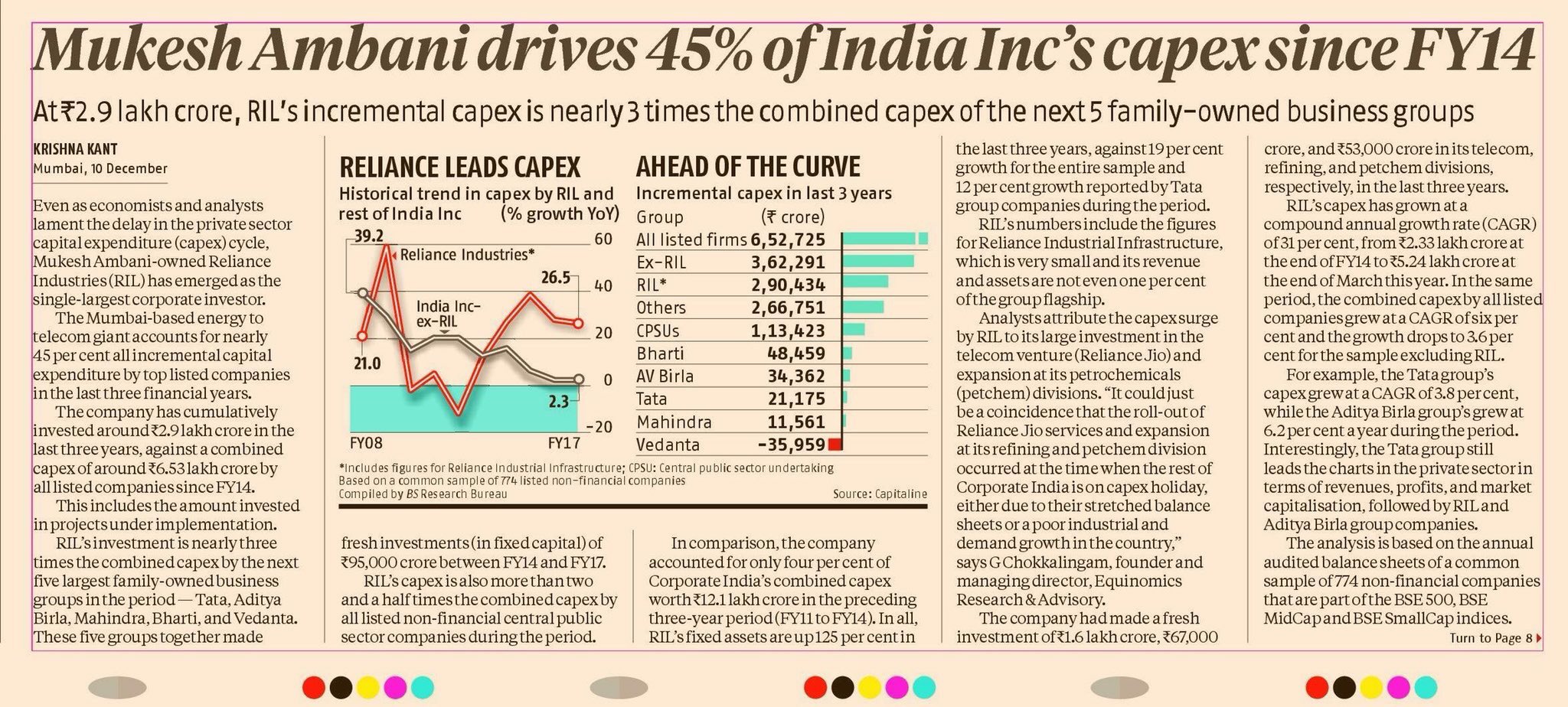
Its interesting to note that no only are Reliance Jio's users the highest data consumers in the world, its also driving India's infrastructure building activity. According to the newspaper report below, Reliance Industries has been responsible for 45% of capex spend in India in the last 3 years.


According to GadgetsNow:
India's current mobile data subscriber penetration stands at 40 per cent which is expected to double to 80 per cent by 2022, according to Crisil's predictions. 
"LTE services have taken the leading role in the unprecedented increase of data users in the past year, in large part thanks to Jio," the report said.
The 3G4G Small cells blog has a post on small cells rollout in India here. In addition, Tareq Amin, Senior Vice President, Reliance Jio Infocomm recently spoke in the TIP summit. His talk is embedded below.


One could argue that rolling out 4G can only be considered successful if the end users can reliably make use of it. According to Opensignal blog:

As we saw in our latest State of LTE report, published in November, LTE availability in India is remarkable: users were able to connect to an LTE signal over 84% of the time, a rise of over 10 percentage points from a year earlier. This places India ahead of more established countries in the 4G landscape such as Sweden, Taiwan, Switzerland or the U.K. 
... 
While LTE availability saw a meteoric rise, the same cannot be said of 4G speeds. In our latest State of LTE report, India occupied the lowest spot among the 77 countries we examined, with average download speeds of 6.1 Mbps, over 10 Mbps lower than the global average. 
A key reason for the strikingly low speeds is the rapid increase in 4G users across all the networks. As 4G adoption rose, and more and more consumers subscribed to 4G services, the networks experienced congestion, resulting in a decrease in average download speeds across the board. 4G users on the networks of Idea, Vodafone and Airtel all witnessed a drop in average 4G download speeds over the course of 2017. 
Meanwhile Jio trended the opposite direction in 4G speed. In our April report Jio had the slowest 4G speed in our India tests, but as soon as Jio’s freebie plan ended in April 2017, we recorded an astonishing 50% increase in their speed (from 3.9 Mbps to 5.8 Mbps) over the course of six months, which still placed Jio at the lowest end of the speed spectrum but with a significantly narrower gap.

When it comes to mobile internet speeds, where 3G and 4G LTE are considered together, India comes in the 109th place in the world according to data collected by Ookla.
Doug Suttles, co-founder and general manager at Ookla said, “Both mobile and fixed broadband internet in India are getting faster, that’s good news for all Indian consumers no matter which operator or plan they use to access the internet. India still has a long way to go to catch up with countries that have top speeds around the world, however, we at Ookla are highly optimistic about the capacity for growth that is available in the Indian market and looks forward to watching how the market grows in this coming new year.”


2018 may probably be the year India gradually transitions from being a developing 4G country to become a full-grown 4G power.

Friday, 13 October 2017

The changing and challenging telecom landscape of India

The telecom landscape of India is changing exponentially. Approximately 215 million subscribers may have to change their allegiances due to the lack of financial stability at Reliance Communications, Aircell and Tata Teleservices (which is on the verge of closing down its operations across India).

The beneficiary is Mukesh Ambani. The oil tycoon who ties with Tencent Holdings Ltd.'s Pony Ma as the third-richest person in Asia is winning subscribers at a rate of 5 million a month by offering free voice calls and cheap data through his operator Reliance Jio. 


“…there are more than 50 crore (500 million) feature phone users who have been left out of the digital revolution,” Ambani said at Reliance Industries’ annual general meeting in Mumbai, where he launched the JioPhone. “This digital disempowerment and unfairness must end. Jio is committing to end it today.”
 In effect, apart from giving telecom companies a run for their money, Reliance Jio is also set to disrupt India’s smartphone market. Launched last September, Reliance Jio already offers free voice calling, as well as the world’s cheapest internet data plan, starting at Rs49 ($0.76) per gigabyte (GB). On the JioPhone, voice calling will “always” be free and unlimited data will cost only Rs153 ($2.38) per month.


Its free schemes and recharge options have expanded Jio’s user base rapidly. Some 66% of Reliance Jio customers were using the service as their primary connection by March, up from 50% in December. The company claims that mobile data usage in India fared around 0.2 billion GB per month in the pre-Jio era. After Reliance Jio’s entry, overall data consumption supposedly skyrocketed to 1.2 billion GB per month, of which 1 billion is consumed by Jio subscribers. According to Ambani the service provider now has over 125 million customers. 

However such radical changes are accompanied by various issues for example with only 300 million smartphone users in the country, the growth could soon hit a wall—hence, the development of the JioPhone, a 4G-enabled feature phone with a large screen and access to apps. More on the JioPhone here. Not to be left behind Airtel and Vodafone India are also launching smartphones. 


So Jio are dynamic enough to offer competitive data rates and a 4G phone but  as a result the prices of wireless data have fallen by about 97% in one year after the entry of Reliance Jio, from about Rs 200 per GB a year ago to about Rs 6 per GB in the June quarter.
While operators like Bharti Airtel and Idea Cellular used to offer 1 GB of data for Rs 250, they now offer about 50 GB for the same price. 

Such massive growth creates its own problems for example: Reliance Jio’s network is “overloaded”, with congestion creating a bottleneck that is slowing down connections for its customers, according to new analysis by OpenSignal. According to this report, Reliance Jio lags behind Airtel, Vodafone, and Idea in terms of 4G speeds, but is market leading in terms of 4G coverage. 

Moreoever what about the ARPU downshift? According to analysts due this reorganisation of subscribers and the very reasonable prices they are paying this is will continue. Reliance Jio has irreversibly changed the market from a pricing-focused one to an ARPU-focused one. In the price-focused market, companies like Vodafone and Airtel tried to keep prices high, volumes low and margins fat. In the volume-based game, pricing is dictated by two factors — the ability of the network to support demand, and the need to increase consumption by users. While the second factor — the need to increase data use — puts a downward pressure on prices, the first factor — network stability and quality concerns — puts a bottom on how low they can be kept.

 Another major issue is spectrum India allows relatively little spectrum for mobile communications, and splits that up among a dozen operators. A lot of radio spectrum is blocked for defence use. The 'Spectrum Crunch' is pretty bad, for example Delhi's top operator has roughly the same number of 3G users as its counterparts in Singapore and Shanghai (about 3 million), but it has about a tenth of their spectrum. As user numbers grow - faster than spectrum availability. And more people will use data, especially video, stressing the network further. This is yet another challenge for the operators. Success in this new telecom landscape depends almost entirely on network capacity. The more capacity the network has, the lower your offering can be priced and the higher consumption can be driven.