Showing posts with label Statistics. Show all posts

Monday, 5 November 2018

AT&T: Winning the Connected Car market in the USA


AT&T has trumpeted their connected car achievements in a recent news article on their website. Their main achievements:

  • Added more than 2 million cars in Q3 2018
  • Bringing the total number of connected cars to nearly 24 million
  • Connect more than 3 million fleet vehicles
  • Relationships with 29 top global brands 
  • Over a million customers on unlimited data plans where they can convert their connected cars into Wi-Fi hotspots
  • Since the introduction of unlimited plans in 2017, subscribers have used 45 million Gigabytes (GB) or 45 Petabytes (PB) of data
  • AT&T global SIM provides IoT connectivity across 500 carriers and 200+ countries and territories. 
  • AT&T connects cars in 57 countries, including 12 where infotainment is enabled through Wi-Fi hotspots.

According to Fierce Wireless:

A number of those automotive companies physically install an AT&T LTE modem into their cars, thus giving customers an option to pay AT&T $20 per month (or $10 per month for existing customers) in order to create a bubble of Wi-Fi connectivity using AT&T’s LTE network for backhaul. (AT&T said it may slow network speeds for customers who use more than 22 GB per month.)

For those motorists who don’t have a car equipped with an AT&T modem, the company recently introduced the Harman “Spark” device that plugs into the on-board diagnostics port (OBD II) in most vehicles built after 1996 and provides Wi-Fi connections alongside vehicle diagnostics and security. (AT&T’s Spark arrived on the market years after Verizon launched its similar Hum device and T-Mobile began selling its SyncUp Drive device.)

In addition to the above achievements, AT&T are very active in V2X standardisation and implementation. Here is what they say:

We’re serving in leadership positions across the industry, joining with other tech leaders to resolve key standards issues. This includes 5GAA, a cross-industry association between the cellular and automotive industries, the Automotive Edge Computing Consortium  of automotive, information technology, telecommunications, and cloud computing sectors, and the Auto-ISAC for automotive cybersecurity information sharing.

We expect vehicle-to-anything (V2X) connectivity technologies will help driverless vehicles to make virtually real-time decisions based on information that goes beyond the individual sensors onboard the vehicle itself.

Vehicles will be able to “see” around corners, in front and behind other vehicles – and at greater distances. This will eventually allow vehicles to quickly make sense of their surrounding environment as well as road ahead to help guide safe and efficient operations on the road.

For self-driving cars to interoperate with their environment and surrounding areas, it will be critical to have connectivity between vehicles, roadside units, pedestrians, and other infrastructure elements while navigating the roadways. Data analysis and decision capabilities will be largely processed onboard the vehicle utilizing various data sources from the vehicles and the surrounding intelligent transportation system.

But one of the most exciting aspects of automated vehicles is their ability to learn from other vehicles’ driving experiences in ways that human drivers simply cannot. This is where our 5G network comes into play. 5G will eventually allow for the necessary distribution of processed data to meet and exceed the needs of the automated vehicle.

The algorithms that govern AV operation can be continually improved as automated vehicles encounter new driving situations. For those improvements to be made, data must be collected, analyzed, and synthesized into improved algorithms to then be distributed to other vehicles. 5G will ultimately help create faster and more efficient exchange of this data, allowing these automated vehicles to distribute and receive data and function even better.

5G multi-gigabit speeds, distributed edge networks, and low latency services can help these capabilities to become a reality in years to come.

And self-driving cars and 5G will ultimately usher new opportunities for in-vehicle entertainment and engagement when drivers have more time on their hands.

Thursday, 25 October 2018

The Rise of Reliance Jio Continues as it Acquires Over 250 Million Subscribers


Reliance Jio announced last week that it has crossed 250,000,000 subscribers. The following are some of the highlights from the announcement (emphasis mine):

  • Jio has accelerated its pace of subscriber additions further with net addition during the quarter of 37.0 million (as against 28.7 million in the previous quarter), highest in any quarter since the launch of commercial services
  • Gross adds at 41.7 million and churn of 4.7 million implying the lowest industry churn rate at 0.66% per month
  • Customer engagement continued to grow with average data consumption per user per month of 11.0 GB and average voice consumption of 761 minutes per user per month
  • Video consumption drove most of the usage, increasing to 410 crore hours per month on the network; average video consumption of 17.5 hours per subscriber per month
  • Further deepening of all-IP 4G LTE network in existing areas along with coverage expansion to 99% of population is on track to be completed in FY19
  • Only network to deploy tri-band (800MHz/ 1800MHz/ 2300MHz) pan-India 4G
  • World’s largest mobile data consumption network which is 5G ready
  • World’s largest VOLTE network, with voice traffic growing consistently
  • JioTV is the best rated live and catch-up TV app; JioCinema is the most popular video-ondemand app; JioMusic and Saavn together is music powerhouse with over 40 million songs; JioMags and JioNews are other highly popular customer offerings
  • Strengthened the KaiOS app-store for JioPhone users with customised versions of popular social media applications like YouTube, WhatsApp and Facebook
  • Reliance Retail Ltd launched the ‘Monsoon Hungama’ offer for JioPhone with upfront security deposit of only ₹ 501 for a new JioPhone during the quarter. The offer works in conjunction with return of an old feature phone. Also, JioPhone 2, which offers a larger screen and full QWERTY keyboard for a price of ₹ 2,999 has been offered through limited period flash sales. Most used social media applications like YouTube, Facebook and WhatsApp are now available for Jio Phone users


I blogged about Jio phone 2 earlier here. JioPhone (1) and JioPhone2 are both feature phones based on KaiOS. In fact I tweeted back in May that Jio has become a leader in feature phones.

According to Telecomtalk, it is widely expected that my March 2020, Reliance Jio will have over 400 million subscribers and over 150 million JioPhone users.

Finally, Communications Today has some interesting charts from Bloomberg. I am going to use one chart below to show how data prices have plummeted in India which is responsible for major uptake of data services.


Related Posts:

Saturday, 31 March 2018

South Korea: KT ready to roll-out 5G in 2019


According to Mobile World Live, KT, the second largest mobile operator in South Korea, announced plans to start commercial 5G service in March 2019, which will make it one of the first operators in the world to launch the next generation mobile technology, Yonhap News Agency reported.

KT’s announcement comes despite the head of its 5G business unit, Lee Yong-gyoo, stating at Mobile World Congress last month it is not yet ploughing ahead with large-scale investment in the technology.


They also recently released a 5G video, explaining their vision


In a recent ITU conference KT also talked about their 5G service implementation at the PyeongChang 2018 Winter olympics. Samsung & Intel had partnered with KT over this event.

According to Fierce Wireless report, 22 5G links at 10 different sites—delivered 3,800 terabytes of data during the two-week event. A prestandard 5G network running in 28 GHz with vendors including Samsung and Ericsson used only line-of-site connections for communications in the millimeter-wave spectrum. KT recorded peak speeds of up to 3.5 Gbps on a 5G Samsung tablet using the network.


According to a report in Netmanias, KT is developing Five network solutions for 5G commercialization in 2019. These are technologies for expanding service coverage and maximizing 5G network performance. The solution development has been completed to 80% level, and it is planned to be completed in the third quarter of this year.

5G slot-integrated structure - LTE has a delay of 4 ms for transmitting Ack signal after receiving data due to difference of upload and download frequency channels. The 5G integrated slot structure transmits the Ack signal at the same time as the data reception in the TDD scheme, so that the delay can be minimized.

5G-LTE interworking structure - In case of shadow area due to discontinuous coverage in initial 5G network, it automatically switches to LTE network and provides seamless service.

Intelligent multi-beam tracking solution - When the user terminal is disconnected from the main base station, the user can access the auxiliary base station and use 5G service seamlessly by grabbing the signal of the peripheral auxiliary base station in addition to the main base station.

In building solutions - 5G frequency is very high in transmission loss due to high frequency band frequency characteristics. KT secures 5G quality by using 5G repeater in offices, premises, underground parking lots, and other buildings.

AI-based network optimization solution - 5G network optimization technology with remote and automation functions. For example, when performing antenna optimization, an engineer is stationed on the LTE site. In 5G, antenna direction and angle are optimized remotely.


Finally, some videos of KT booth and 5G equipment from Mobile World Congress 2018.

Saturday, 13 January 2018

Overview: Indonesia Mobile Operators and 4G development

Mobile Operators in the sprawling archipelago nation of Indonesia are transitioning their networks  to meet the demands of the latest technologies and an increasingly connected population.

Indonesia, a country with nearly 410 million mobile connections, experienced rapid uptake of 4G services over the past year, with connections increasing 2.5-times and LTE penetration hitting 21 per cent.

The country’s 4G connections jumped from 34 million in Q3 2016 to 85.5 million in Q3 2017, according to data from GSMA Intelligence (GSMAi). LTE penetration in Q3 2016 stood 7.9 per cent.

To support the growth, mobile operators almost doubled the number of 4G base stations deployed in the opening six months of 2017, with 55,700 sites at end-July compared with 26,000 at end-2016.


In developed countries, the internet is everywhere. In homes, if not then readily available in schools, coffee shops and libraries. In developing countries this is not the case, if it were not for mobile phones, millions of people would be left on the losing side of the divide. As we can see in this chart, the vast of majority of people in Indonesia (and other countries) use the internet exclusively on mobile devices

COTD_11.15


The country’s mobile market was characterised for many years by the large number of players licensed by the local regulator. Seven mobile operators are competing for revenues in the Indonesian market: Telkomsel, Indosat, XL Axiata, 3 Indonesia, SmartFren, Bolt and Bakrie Telecom (BTel). Market leader Telkomsel continues to maintain a huge presence but is under increased threat from the competition.


Telkomsel has a market share of about 44% in Indonesia and is the only operator which is active in all provinces. It had 180 million users in late 2017 making it the 6th largest cellular provider in the world. It is 65% owned by the state through Telekom Indonesia, the remainder owned by Singapore Telecom.

The operator, with a 44 per cent market share, sourced network equipment for the deployment from Ericsson, Huawei, Nokia and ZTE. It is using 20MHz of 1.8GHz spectrum combined with 4×4 MIMO technology in the country’s capital city Jakarta and also Medan, Bandung, Denpasar, Mataram, Pontianak, Makassar, Manado and Ambon.

Telkomsel paid Rp 1.01 trillion ($74.7 million) to secure a license for a 30-megahertz band on the 2.3 gigahertz spectrum, which will enhance its capacity to offer wireless broadband services across the country.The new license means that Telkomsel now has a total band of 77.5 MHz on the 2.3 GHz, 2.1 GHz, 1.8 GHz, 900 MHz and 800 MHz spectrums.


The operator said they have deployed at least 5,200 4G base stations in 180 cities across the country to date. It had about 12 million 4G subscribers in Q3 2017 and expects to have 15 million by the end of the year, accounting for nearly 9 per cent  of its mobile users, according to GSMA Intelligence.

According to Open Signal Telkomsel was well ahead of its rivals in 4G speed, averaging downloads of 14.6 Mbps in their tests. However 4G availability was where they fell behind their rivals. 


Indosat         

Indosat, Indonesia's second-largest telecommunications operator had about 82 million mobile subscribers last year, compared with Telkomsel's 180 million.  It has a good coverage on the main islands of Java, Bali, Kalimatan, Sulawesi and Sumatra, at low prices. 4G/LTE has started in Jakarta, Bandung, Yogyakarta and Bali and is available in about 94 cities at the end of 2016 on 900 and 1800 MHz with speeds up to 185 Mbps: 4G coverage map. In 2017 they bid for further spectrum on 2100 MHz.


XL Axiata

XL Axiata is the 3rd provider in Indonesia. According to its website they have 46.5 million subscribers.  It is owned by Axiata Ltd. and has about a 90% coverage on these islands: Java, Bali and Lombok. Furthermore, it covers cities on Sumatra, Kalimatan, Sulawesi and a very limited coverage on Papua. Where it has 3G, speeds are often faster then Telkomsel. 4G/LTE has started in Jakarta, Medan, Yogyakarta and is spread to other regions like Bali, Lombok, Surabaya and East Kalimatan and Sulawesi on 900 and 1800 MHz.

As at 31 October 2017, XL Axiata says it had  rolled out 4G LTE services to around 100 towns and cities in Indonesia and had more than 20 million 4G subscribers nationwide, using a network comprising 16,000 BTS. At the same date, its total number of ‘on-air’ base stations had reached nearly 100,000, of which more than 44,000 were 3G-equipped.


Tri indonesia

3 called Tri in Indonesia is now the 4th provider with approximately 21 million  subscribers  previously with the lowest coverage, but the cheapest rates. However the mobile operator controlled by Hong Kong-based CK Hutchison, has revealed that its in-deployment 4G LTE network is now available in 227 cities and districts, including 1,769 sub-districts and 7,296 villages in 25 provinces. Their coverage extends from Lhokseumawe to Manado, and includes the islands of Sumatra, Kalimantan, Sulawesi, Java and Bali. Commenting on the development, Tri Indonesia President Director Randeep Sing Sekhon said: 
‘Digital and multimedia services are expected to experience rapid growth this year. And in future the success of these services is reliant on [Tri rolling out] mobile internet infrastructure to support growth, as it is expected to become the main channel to carry such services’.
People wishing to sign up to the Tri 4G LTE network will need to buy a suitable 4G LTE SIM card and handset. Customers can exchange their old Tri 3G to 4G SIM card without extra charge at any 3Store.

Tri currently has a total capacity of 25 MHz -- 10 MHz in 1,800 MHz frequency and 15 MHz in 2.1 GHz frequency.


Smartfren Telecom


Smartfren owned by Indonesian PT Smartfren Telecom Tbk is a major player in the country. It had around 13 million customers in 2016 and has now migrated entirely to LTE. In 2016 Smartfren started the most widespread andfastest LTE in the country so far. It employs LTE Advanced that reaches higher speeds through carrier aggregation. But two rare frequencies are used: 850 MHz FDD (Band 5) and 2300 MHz TDD (Band 40). Already 5 million customers have been migrated to LTE. 

Smartfren's coverage is on the islands of Java and Bali, parts of Sumatra, Sulawesi, Lombok and Kalimantan. It started 4G/LTE in 25 centers so far and reaches 188 cities in 2016.

Since Smartfren phased out its 3G network, it has an impressive 4G network in terms of reach for those 2G and 3G customers to migrate to. According to Open Signal Smartfren testers were able to find an LTE signal more than 90% of the time, winning Smartfren their 4G availability award.
Bolt!
Bolt! owned by Internux is an Indonesian wireless broadband provider based on TD-LTE. It started in 2014 and has already 3 million customers in 2017. It uses the rare 2300 MHz TD-LTE (band 40) that is not covered by usual devices. That's why you are likely to buy new hardware for them. It only operates so far in the cities of Jakarta and Medan. Therefore it's more like a substitute for a landline ADSL-provider than a travel option.


The smallest and troubled mobile operator owes the government millions of dollars in licence and frequency rights fees. It originally launched CDMA service in 2003 in Jakarta, West Java and Banten and started to offer fixed wireless service in 2007. It had about eight million subscribers at its peak. Last year the Ministry of Communications and Information Technology revoked its fixed wireless access (FWA) and fixed licences. Huawei have recently acquired a near 17 per cent stake in Bakrie Telecom. 


Questions for the future: Can the Indonesian market sustain this number of mobile operators? Who will win the 4G and subsequent 5G race? 

Friday, 15 December 2017

Disruptive Reliance Jio on the road to 4G leadership

Continuing from our earlier post on India in October.

According to this BGR news report:
2017 was a significant year for Indian telecom during which 4G became the new norm. Usage exploded riding primarily on Reliance Jio — the 15-month old network that is already the world’s fastest-growing telco — and the effects trickled down to other operators too. Nearly 4 million TB of 4G data has been consumed by Indians this year, according to a TRAI estimate. Consumers relished swathes of data sometimes “effectively free” and sometimes at incredibly low prices, and hordes of first-time smartphone buyers were inducted into the world of mobile data. The year came to be defined by the stiff price war between incumbent telcos and disruptor Jio.
According to this tweet by Neil Shah, Counter Point:


4G LTE subscriptions: 135 Million
Data Consumption : 10GB per month / user
VoLTE calls : 626 minutes per month / user
Video Consumption: 14 hrs per month / user


A similar picture was reported by Tefficient:
These customers generated 3780 petabyte of mobile data. It's by far the biggest network in the world. The graph suggests that might be around 80% of India's total - Q3 isn't reported by the others yet. Per subscription, that is 9,6 GB per month which means that Jio might challenge the global usage leaders of the world - 3 Austria, DNA and Elisa Finland and FarEasTone and Taiwan Mobile from Taiwan.


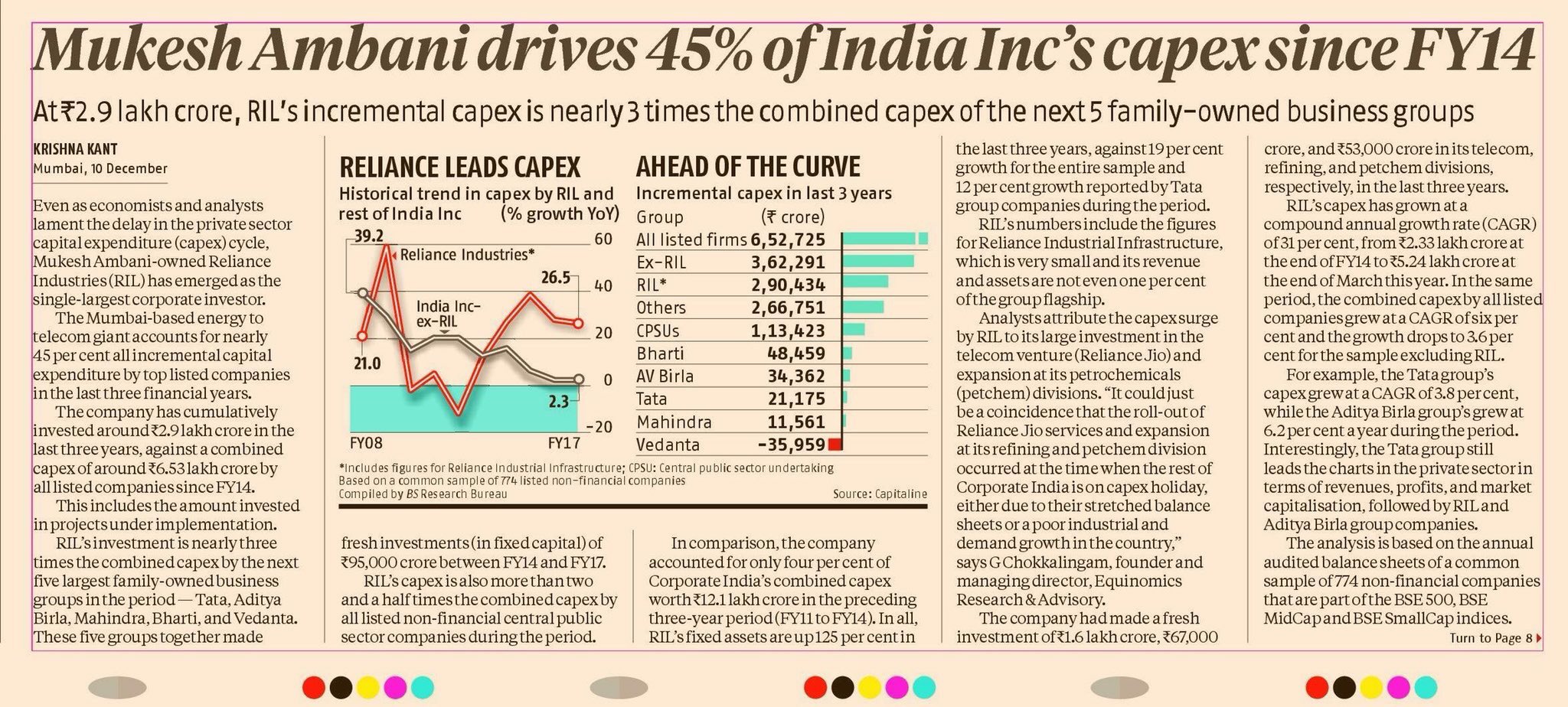
Its interesting to note that no only are Reliance Jio's users the highest data consumers in the world, its also driving India's infrastructure building activity. According to the newspaper report below, Reliance Industries has been responsible for 45% of capex spend in India in the last 3 years.


According to GadgetsNow:
India's current mobile data subscriber penetration stands at 40 per cent which is expected to double to 80 per cent by 2022, according to Crisil's predictions. 
"LTE services have taken the leading role in the unprecedented increase of data users in the past year, in large part thanks to Jio," the report said.
The 3G4G Small cells blog has a post on small cells rollout in India here. In addition, Tareq Amin, Senior Vice President, Reliance Jio Infocomm recently spoke in the TIP summit. His talk is embedded below.


One could argue that rolling out 4G can only be considered successful if the end users can reliably make use of it. According to Opensignal blog:

As we saw in our latest State of LTE report, published in November, LTE availability in India is remarkable: users were able to connect to an LTE signal over 84% of the time, a rise of over 10 percentage points from a year earlier. This places India ahead of more established countries in the 4G landscape such as Sweden, Taiwan, Switzerland or the U.K. 
... 
While LTE availability saw a meteoric rise, the same cannot be said of 4G speeds. In our latest State of LTE report, India occupied the lowest spot among the 77 countries we examined, with average download speeds of 6.1 Mbps, over 10 Mbps lower than the global average. 
A key reason for the strikingly low speeds is the rapid increase in 4G users across all the networks. As 4G adoption rose, and more and more consumers subscribed to 4G services, the networks experienced congestion, resulting in a decrease in average download speeds across the board. 4G users on the networks of Idea, Vodafone and Airtel all witnessed a drop in average 4G download speeds over the course of 2017. 
Meanwhile Jio trended the opposite direction in 4G speed. In our April report Jio had the slowest 4G speed in our India tests, but as soon as Jio’s freebie plan ended in April 2017, we recorded an astonishing 50% increase in their speed (from 3.9 Mbps to 5.8 Mbps) over the course of six months, which still placed Jio at the lowest end of the speed spectrum but with a significantly narrower gap.

When it comes to mobile internet speeds, where 3G and 4G LTE are considered together, India comes in the 109th place in the world according to data collected by Ookla.
Doug Suttles, co-founder and general manager at Ookla said, “Both mobile and fixed broadband internet in India are getting faster, that’s good news for all Indian consumers no matter which operator or plan they use to access the internet. India still has a long way to go to catch up with countries that have top speeds around the world, however, we at Ookla are highly optimistic about the capacity for growth that is available in the Indian market and looks forward to watching how the market grows in this coming new year.”


2018 may probably be the year India gradually transitions from being a developing 4G country to become a full-grown 4G power.

Thursday, 20 November 2014

Country Overview: Pakistan

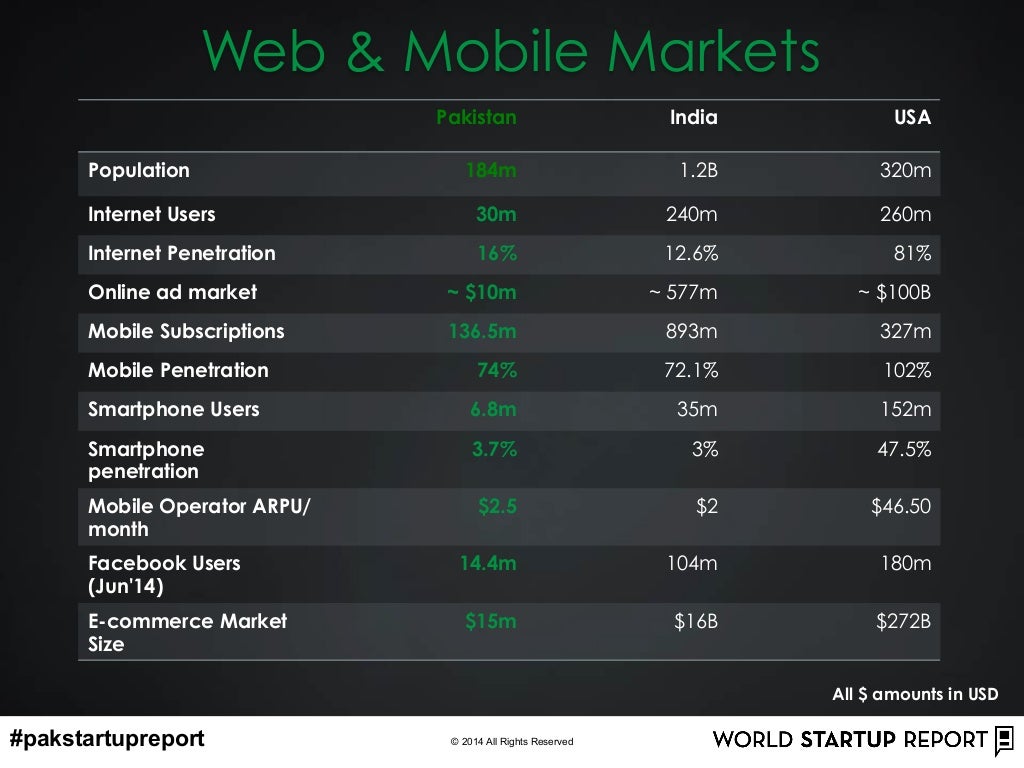
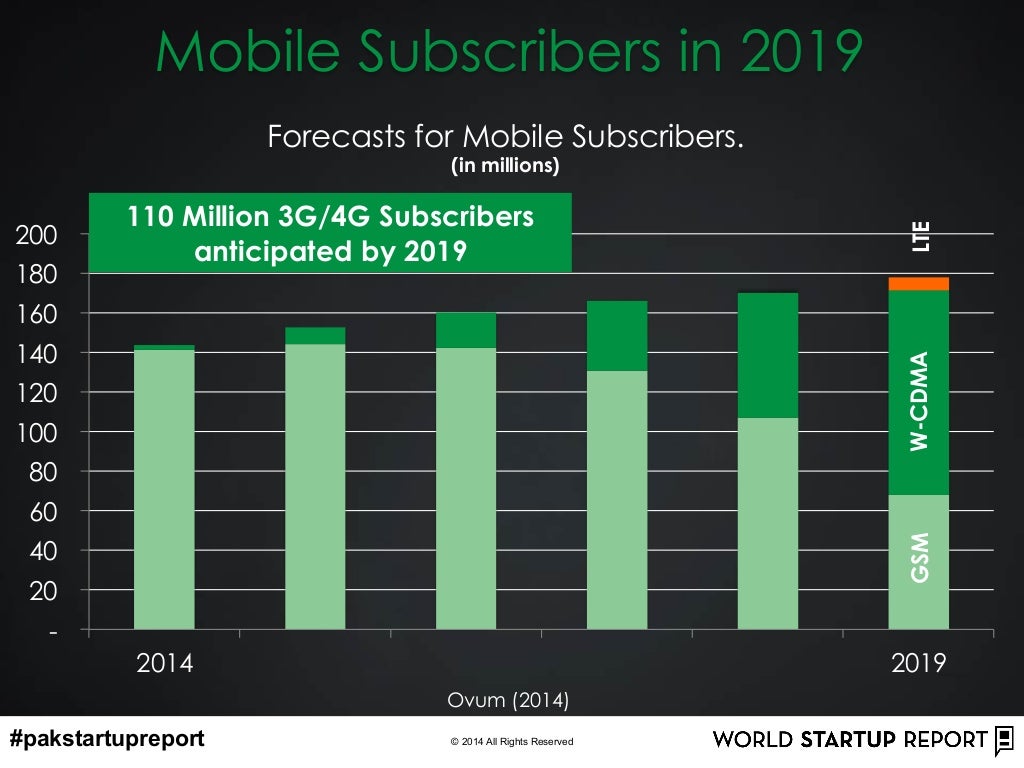
This seemingly struggling nation has one of the highest rates of cell phone usage and penetration in South Asia. Close to 140 million people have a cell phone connection in Pakistan, and they enjoy some of the cheapest service rates in the global market.

  • Of Pakistan’s 180 million people, 68 percent are under 30 (compared to 63 percent in India, 40 percent in the US)
  • Pakistan expects to have 110 million 3G or 4G subscribers by 2019
  • Pakistan has the fourth largest middle class population in developing Asia
  • 30 million internet users
  • 6.8 million smartphone users


Mobile Internet is also widely used in Pakistan, which has led to operators introducing 3G and 4G services in the country. One of these operators, China Mobile’s Zong – the world’s largest mobile network operator – invested $516 million in acquiring 3G and 4G licenses and is currently the only operator providing the latter.

Zong is Pakistan’s fourth biggest mobile telco.

In March 2014 Zong surpassed 25 million customers, out of a total of 125 million mobile subscribers in Pakistan. Mobiilink remains number one with over 38 million subscribers, Telenor is second with 33 million, and Ufone is third with 26 million. Warid is down in fifth with 13 million.

Mobile subscribers in Pakistan - to January 2014

Wednesday, 18 June 2014

New Zealand Mobile Operator Overview


As of March 2011, the penetration rate in New Zealand was estimated at 124.326% over a population estimate of around 4.3 million.
Vodafone and NZ incumbent, Telecom, have announced recently announced their mid-year subscriber figures and industry researcher IDC estimates that the country has now officially passed the 100% penetration mark to reach 101%, or 4.25 million mobile subscribers. This means that growth for the country's only two mobile phone carriers is reduced to stealing customers from each other - or as has happened in the past year - convince people they need a phone on both networks.
"The New Zealand mobile market is reasonably unique with a high level of maturity and above 100% penetration, yet only two operators present. Interestingly, we've hit 100% mobile penetration before Australia has. Last year, New Zealand saw an upheaval in the Internet sector, with the mobile space looking set to be next," said IDC telecommunications analyst, Darian Bird.
Let's not forget 2degrees. New Zealand's third mobile carrier possibly already has more customers than Telecom NZ. It is currently positioned as the low-cost alternative. If 2degrees does nothing else, it puts price pressure on Vodafone and Telecom NZ.
But it does do something else. Something important. While 2degrees is playing catch-up in areas like 4G, it has been innovative in finding new ways to sell wireless services. The company's carryover plans and ability to share data between accounts have helped reshape the market.
So why is the mobile market flowering now? The arrival of a third carrier in the shape of 2degrees made much of the difference. Once it reached critical mass, Vodafone and Telecom NZ had to lift their games. All New Zealand mobile customers owe 2degrees founder Tex Edwards a debt for making that possible.
Telecom Corp., New Zealand's second-biggest mobile phone operator, has been cleared to buy the final lot of 700 megahertz radio spectrum, flagged for fourth-generation mobile use, after proposed government allocations made it unlikely Two Degrees Mobile would gain any benefit if it managed to acquire the spectrum.
Telecom chief executive Simon Moutter said the clearance means the country's biggest telecommunications company will benefit its customers with faster speeds and more capacity on its 4G network.
"This fourth lot puts Telecom in the best position in the market to deliver a very high-performance 4G mobile network for New Zealand, including in less densely populated areas," Moutter said in a statement.
Telecom bought the fourth 2x5 MHz for $83 million in the second round of a government auction, having secured three lots of 2x15 MHz spectrum for $66 million in the first round. Vodafone missed out on the fourth lot, having bought three 2x15 MHz lots for $66 million in the first round, while 2degrees bought two lots of 2x10 MHz spectrum for $44 million.
While some 4G capability is already available on higher MHz spectrum, the 700MHz range is especially well-suited to pushing fast mobile broadband into rural areas because it requires fewer repeater stations to achieve coverage and into densely populated urban settings, such as commercial buildings.
As part of the auction’s conditions, the mobile phone operators will have to upgrade existing rural cell sites to 4G capability within five years and continue to expand their coverage. That’s to ensure at least 90 percent of the country has access to a 4G network within five years.
Source.

Black+White launched with much fanfare but has almost vanished since then. CallPlus and Orcon –both big-name brands in the ISP space – have mobile offerings but you’d be hard pressed to find anyone using them. The plans seem uninspired somehow and certainly can’t compete with the big names, Vodafone and Telecom, despite using their networks.
In Australia MVNOs account for 13% of the market, yet in New Zealand the total for all MVNO offerings is probably in single figures.
I think I can see why – MVNOs in New Zealand are on account only, and New Zealand is predominantly a prepay market. Immediately, most of New Zealand’s customers are unable to consider switching to an MVNO provider because there is no prepay option.

Friday, 13 June 2014

Malaysia Mobile Operator Overview


As of March 2011, the penetration rate in Malaysia was estimated at 117.635% over a population estimate of around 29 million.

Source.

Malaysia has 12 MVNOs and counting. Source.

In Malaysia, an interesting trend observed is that smaller mobile virtual network operators (MVNOs)  have been steadily eroding prepaid market share from the Big Three cellular providers Maxis Bhd (Maxis),  Celcom Axiata Bhd (Celcom) and DiGi.Com Bhd (DiGi).

Malaysia’s rate of 140 per cent exceeds that of developed markets such as South Korea with 111 per cent and Taiwan’s rate of 127 per cent, and is among the highest in Asia.

In fact, it pointed out that Malaysia is closing fast on the gap with Hong Kong (230 per cent), Singapore (152 per cent) and Vietnam (149 per cent), the only three countries which have higher mobile penetration.
Source 


Thursday, 12 June 2014

Sri Lanka Mobile Operator Overview


As of December 2013, the penetration rate in Sri Lanka was estimated at 99.2% over a population estimate of over around 20.3 million.
The country's telecom regulator is the Telecommunications Regulatory Commission of Sri Lanka (TRCSL).
Source.


Around 45-50% of people in Sri Lanka own a mobile phone now. Although this is higher
in comparison to South Asia (30%) and the developing world (40%), mobile ownership in

Sri Lanka is well below that in mature markets which typically see rates of 60-80%.


Source.

Friday, 1 February 2013